If you've lost hope for Uptober, remember that November has historically been one of #Bitcoin 's most bullish months according to seasonality data. 10 days left before October Monthly closing Upvember. image
Elon promotes "X Chat" as private messaging but... Elon Musk assures that even if someone put a gun to his head, he could not access your messages: "Messages are fully encrypted, with no advertising hooks or strange "AWS dependencies," so I can't read your messages even if someone puts a gun to my head. You will also be able to make file transfers and audio/video calls." However, we can find this in the X help center: https://help.x.com/en/using-x/encrypted-direct-messages "Currently, we do not offer protection against man-in-the-middle attacks. As a result, if someone—a malicious employee or X itself as a result of a mandatory legal process—compromised an encrypted conversation, neither the sender nor the recipient would know. However, we are working on mechanisms for a future version that: · will allow devices to verify the authenticity of the content and the origin of a message (through "signature checks"); and · will allow a pair of users to verify the devices that have access to their encrypted conversations (through "security numbers"). When signature checks and security numbers are implemented, man-in-the-middle attacks should be difficult, if not impossible, and both senders and recipients should be alerted in case of an attack."
#Bitcoin for Signal - Private Messaging Needs Private Money. Signal is a trusted messenger that enables private communication and aims to extend this privacy to financial transactions. Signal initially integrated MobileCoin for payments, but it failed to gain significant adoption. The proposed solution involves integrating Bitcoin with the Cashu protocol to enable private, peer-to-peer payments within Signal. Cashu is a Chaumian ecash system that provides strong privacy and allows for instant, cheap payments, even for tiny amounts. The Cashu protocol is open-source and not controlled by a single entity, allowing for community-driven development and implementation. The Signal Cashu integration embeds a lightweight Cashu wallet directly into Signal, making Bitcoin payments as natural as sending a message. Cashu uses blind signatures and other cryptographic techniques to ensure user privacy and unlinkability of transactions. The Cashu protocol is defined by a set of open specifications called NUTs (Notation, Usage, and Terminology). The proof-of-concept demonstrates that Bitcoin in Signal is technically feasible with Cashu, and the team seeks support and collaboration from the community and Signal itself. Cashu aligns with Signal's privacy-first mission and could bring millions of potential new users, enhancing privacy for everyone. https://bitcoinforsignal.org/
Some people feel envious when you're happy living your life differently because they made life choices based on what others are doing rather than what's good for them. When they suffer as a result of it, they want you to suffer too so that they don't feel bad about those choices.
About the recent #BTC Crash: What was the cause? Rumors.. Before discussing the current market situation, I would like to share with you the most probable reason for what happened on Friday (without conspiracy theories). The Binance exchange allowed the use of USDe (the ENA stablecoin), wBETH (wrapped ether), and BNSOL as collateral for margin positions. But there was a problem with the exchange. The exchange's system valued these 3 assets based on the price in its own order book, rather than relying on external sources. This means that if someone inside the exchange dumps a critical volume of these assets, their price would instantly drop. The exchange's internal system would automatically consider the collateral assets depreciated and start liquidating clients' positions. The exchange knew about this problem and announced on October 6th that it would switch from its own order book to oracles (a service that takes price data for an asset from all sources and provides an average value - giving an objective price and not accounting for manipulations on individual exchanges). However, the new system was only scheduled to start working on October 14th (8 days remained until the vulnerability was closed). On October 10th, a large whale, who owns coins from the Satoshi Nakamoto era of Bitcoin (since 2011) and had been actively moving them to Ethereum in recent months, opened a SHORT position of over $1,000,000,000 on BTC and ETH on the HyperLiquid exchange (most likely a close insider). Just a few minutes before Trump began making aggressive statements about China and announcing new tariffs... At that moment, someone intentionally dumped ~80M USDe on Binance (the price inside the exchange dropped from $1 to $0.65 - while it remained stable everywhere else). If oracles had been working, everything would have been fine. But the exchange's system, relying on the quote in its order book, decided that the "collateral" had depreciated and began liquidations of around ~$800M - $1B (including market maker positions). Against the backdrop of Trump's statements, the crowd was in a state of panic and started closing their long positions / getting liquidated (selling), opening short positions (selling), dumping spot on emotions (selling). The algorithms of the largest exchanges/managers are oriented towards Binance (the largest and most liquid exchange) and automatically started selling/hedging/reducing liquidity to avoid losses. And instantly, the $80M USDe dump in the order book, combined with the panic from the news, triggered an unprecedented cascade of liquidations of ~$19B according to public data, and more than $80B (according to rumors). Outcomes: 1. The short positions of the insider whale from the Satoshi Nakamoto era made a profit of $192M in a matter of minutes (and he has been converting his bitcoins to ether all year - he believes in the growth prospects of the alt market). 2. The market was completely cleared of leverage, loans (favorable). The capital of overconfident retail investors moved into the hands of insiders. 3. Binance has already stated that the technical problems were on their end and they are fixing the situation (switching to oracles), which means it is very likely that something similar will not happen again (now everyone will be afraid of a repeat). And technology like ChainLink is necessary for the stable functioning of exchanges in the future. The situation is terrible, insidious, but the market is also high-risk. Most likely, this is a one-time, systemic problem and will be fixed soon. The manipulation was "covered" by the news of Trump's speech. CZ is silent (although he usually urges to buy the dip and not panic), this is unsettling. From the beginning of the week, we will get more accurate data on what happened, the guilty parties, the consequences for them, and the victims (it might be volatile).
In the next couple of years, 24GB and even 32GB RAM on phones will feel less
🔄 REPOSTING FROM REDDIT 🚨 Post: Why centralised KYC exchanges allow ZEC. Clarification on the current state of ZEC Trusted Setup in their production blockchain. I have conducted a small research with DeepSeek and real persons from r/zec involved, and the conclusion is the following: Indeed, ZEC production blockchain has been upgraded to the Halo2 cryptographic system that allows to gradually eliminate and fade out the dependence on the well known and pain famous Trusted Setup ceremony by systematic updates of the Universal Reference String (URS). Halo2 does theoretically allow any blockchain participant to update the URS by some procedure. But DE FACTO, the URS string generated in the Trusted Setup ceremony stays UNMODIFIED on the current production blockchain of ZEC. This fact signifies if just one of the ceremony participants has not wiped out his key, all the ZEC hidden transactions on the production blockchain still can be traced out. Furthermore, in ZEC network, no production blockchain participant can easily update the URS because it does require the whole ZEC network protocol upgrade used in the production blockchain. The decision on protocol upgrade can be made only by ZEC core developers in their Electric Coin Company (ECC). It is like a hard fork, thus, extremely epic operation, that involves into cooperation all the blockchain participants. So, if just one key from Trusted Setup has not been wiped out, all the hidden transactions on the ZEC production blockchain can be traced by 3rd party, namely FBI and other 3-letters agencies belong to government authorities. That’s why ZEC can be easily listed on virtually all KYC centralised exchanges: a dedicated group of people can trace all the hidden transactions because there exists a key that has not been properly wiped out. Note, at the methodological point of view, we have no duty to prove there exists a key that has not been wiped out, it is SUFFICIENT we can’t prove it HAS BEEN wiped out. So, being growing in listings on KYC centralised exchanges, the ZEC price is skyrocketing, what we do exactly observe. 🚨 OP comments: 1. Pegasus malware backed by government, etc etc. 2. If the toxic waste for the production URS exists and is known to an adversary, then the privacy and integrity of the current ZCash production blockchain's Orchard pool are broken: All the today-made hidden transactions can be gradually traced out. ZEC coins can be created from thin air and spent out. That’s exactly why Halo2 was introduced at all: it allows a gradual RECOVERY from the compromised state to the secure state by updating URS value in the new Trusted Setup from URS1 (proven compromised) to URS2 (considered as honest). In a nutshell: if ZEC core devs do share URS1 , URS2, etc with FBI, the total project is a fully devastating SCAM. Halo2 can’t save us in this situation. Unlike in Monero only open source code matters. Monero core devs CAN NOT share something with FBI to explore our transactions! Now you see how devastating is the world: ZEC is skyrocketing and Nobody cares IT IS NOT a privacy coin at all. Because, I repeat, at methodological point of view we have no duty to prove that URS value is not compromised. It is SUFFICIENT we can’t prove it IS NOT compromised (by FBI, etc). ZEC is a fatal and fundamental philosophical SCAM because we always MUST TRUST in ZEC network. Actually, ZEC is an ideal model for traditional KYC financial institutions where a dedicated group of people MUST know all your transaction history. That’s precisely why they meet KYC so easily, appearing on most centralised exchanges and their price is skyrocketing like Bitcoin price. But, while Bitcoin does declare it is NOT private , it is NOT a scam. But ZEC declares it is Private but actually it is NOT, so they simply directly, pedantically lie. So they are SCAM by definition. https://www.reddit.com/r/Monero/comments/1o453e3/why_centralised_kyc_exchanges_allow_zec/
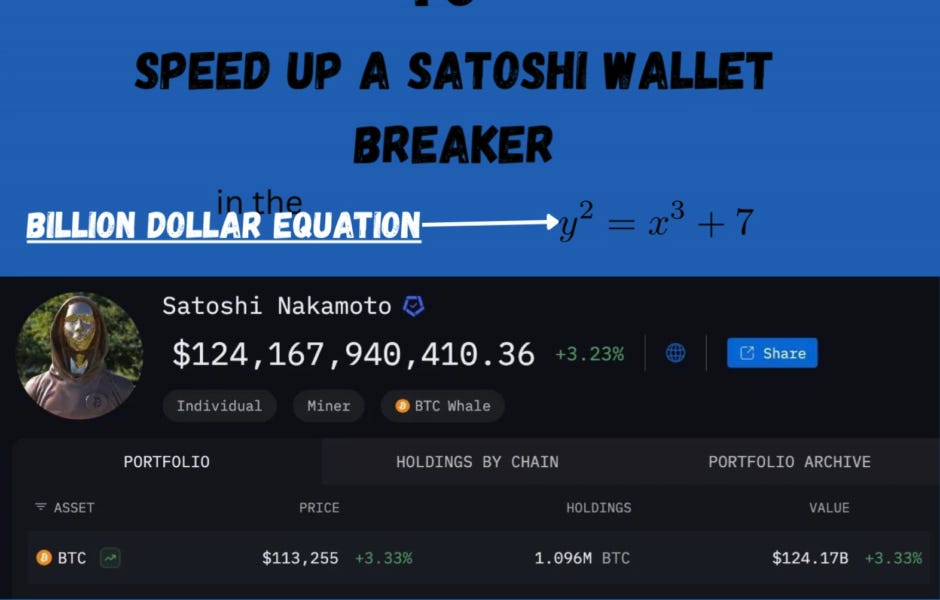
A programmer has revealed that his side project is “going for Satoshi’s wallet." He has shared a post on Substack outlining plans to use group-theory math and optimized elliptic-curve code to try to crack the Bitcoin founder’s keys. https://www.reddit.com/r/hacking/comments/1nyr4x0/i_used_all_the_math_i_know_to_go_from_352_miilion/
The way to live is to create. Die empty. Get every idea out of your head and into reality.
An important study on the effects of smartphones on our cognitive ability. Brain Drain: The Mere Presence of One’s Own Smartphone Reduces Available Cognitive Capacity "The proliferation of smartphones represents a profound shift in the relationship between consumers and technology. Across human history, the vast majority of innovations have occupied a defined space in consumers’ lives; they have been constrained by the functions they perform and the locations they inhabit. Smartphones transcend these limitations. They are consumers’ constant companions, offering unprecedented connection to information, entertainment, and each other. They play an integral role in the lives of billions of consumers worldwide and, as a result, have vast potential to influence consumer welfare—both for better and for worse. The present research identifies a potentially costly side effect of the integration of smartphones into daily life: smartphone-induced “brain drain.” We provide evidence that the mere presence of consumers’ smartphones can adversely affect two measures of cognitive capacity—available working memory capacity and functional fluid intelligence—without interrupting sustained attention or increasing the frequency of phone-related thoughts. Consumers who were engaged with ongoing cognitive tasks were able to keep their phones not just out of their hands, but also out of their (conscious) minds; however, the mere presence of these devices left fewer attentional resources available for engaging with the task at hand. Further, we find that the effects of smartphone salience on available cognitive capacity are moderated by individual differences in the personal relevance of these devices (operationalized in terms of smartphone dependence); those who depend most on their devices suffer the most from their salience, and benefit the most from their absence. The role of dependence in determining mere presence effects suggests that similar cognitive costs would not be incurred by the presence of just any product, device, or even phone. We submit that few, if any, stimuli are both so personally relevant and so perpetually present as consumers’ own smartphones. However, we leave open the door for our insights to apply more broadly to future connective technologies that may become equally central to consumers’ lives as technology continues to advance." https://www.journals.uchicago.edu/doi/full/10.1086/691462