#Antifa #PortlandOR #PDX #ICESucks #DHS #KristiNoemSucks #Portlandia #Humor image
Mesmerize, mesmerize! Socialism is scary...FOR THE RICH! #Socialism #SocialistVampires #Humor #Spooky
#Cob, a #vernacular earth #construction process in the context of modern #sustainable building Erwan Hamard, et al. "The will of reducing environmental and social impact of building industry has led to a renewed interest in #EarthConstruction. Most of earth construction literature dealt with #RammedEarth or #Adobe techniques, but very little with cob. Yet, cob participates in the diversity of #vernacular earth construction processes that value local materials and is an alternative to rammed earth and adobe in specific geographical conditions. "#Conservation of cob heritage also requires a better knowledge of this vernacular construction process. This bibliographical analysis gathered extensive data on cob process and summarized the different cob process variations, attempting to take into account their diversity. This analysis allowed us to provide novel data on cob process, and more specifically, a clear definition of cob with regard to other earth construction processes, a first summarized description of cob process that clearly distinguished its variations, a list of fibres traditionally employed, values and, if possible, average and standard deviation for fibre length, fibre content, manufacture water content, drying times, lift heights and wall thicknesses, a summary of the strategies to manage shrinkage cracks, a criterion on the quality of implementation and/or earth for cob, based on slenderness ration of lifts and a discussion on the evolution of cob process with regard to societal evolutions." https://www.sciencedirect.com/science/article/abs/pii/S0360132316302165 #SolarPunkSunday #SustainableMaterials #AncientTechnologies #Adaptation #SustainableConstruction #CobBuilding #BuildingMaintenance #HistoricPreservation #Restoration #NewBuildingTechniques #History #Science
An Experienced Wood Firer Shares #Kiln Plans for a Small Instructional #WoodFiredKiln Design your own wood kiln using these wood kiln plans! by John Thies Excerpt: "I set out to build a very versatile and efficient wood-firing kiln that could be used by students who had interest in a complete hands-on experience, from the preparation, loading, firing and unloading to the final clean-up phase. I didn't want to interfere with the successful larger firings, in which students can get a large volume of wood-fired pots without the in-depth hands-on experience. The new kiln would allow me to cut down on the extensive labor, fuel and overhead costs of my larger kiln. I named the new kiln '#Manabigama' at the suggestion of my friend Phil Berneburg, former technical editor for CM. In #Japanese, mana means educational or learning, bi means a thing of beauty, and gama means kiln. The Manabigama is a traditional design with a few simple modifications. I see it as a cross between an #AnagamaKiln and a #GroundhogStyleKiln. Basically, it is a crossdraft tube built into the side of a hill. The overall interior dimensions are 24 inches in width, 7 feet in depth, 40 inches in height. Its firebox is in the front, incorporated into the inside with a grate system, and extra air intakes are built into the front and sides. This is done to provide more secondary air intake to help burn green or wet fuel. The firebox is plenty adequate being 2 feet wide, 2 feet deep and 30 inches high from the floor to ware level. The chimney has inside dimensions of 9 inches deep by 18 inches wide and is 12 feet high. The shape is a long rectangle with two straight, 18-inch-tall side walls and a catenary arch built on top. This creates ample headroom for ease of loading, as well as extra height for stacking and tall pieces. There is approximately 24 cubic feet of ware space, more than enough for teaching purposes. The kiln door is in front, only halfway down, and is bricked up including the stoke hole. It can be loaded in two to three hours, fires evenly to Cone 10-12 in eight hours tops, or if you choose, you can fire two to three days depending on how much ash buildup you like. The consumption of fuel is also minimal-less than half a cord of wood. When loading the wood kiln, be sure to use wadding to prevent pots from sticking to shelves. All in all, the Manabigama is a very simple design to build. It is capable of yielding wonderful ash-glazed pieces with a minimum of labor, fuel and overhead costs. And it is a fantastic wood-fired kiln for teaching without the tremendous strain of a large three-chambered kiln." #SolarPunkSunday #WoodFiredKiln #DIY #Kilns #Pottery #Quicklime? #DIYKilns #TraditionalTechnology #Adaptation

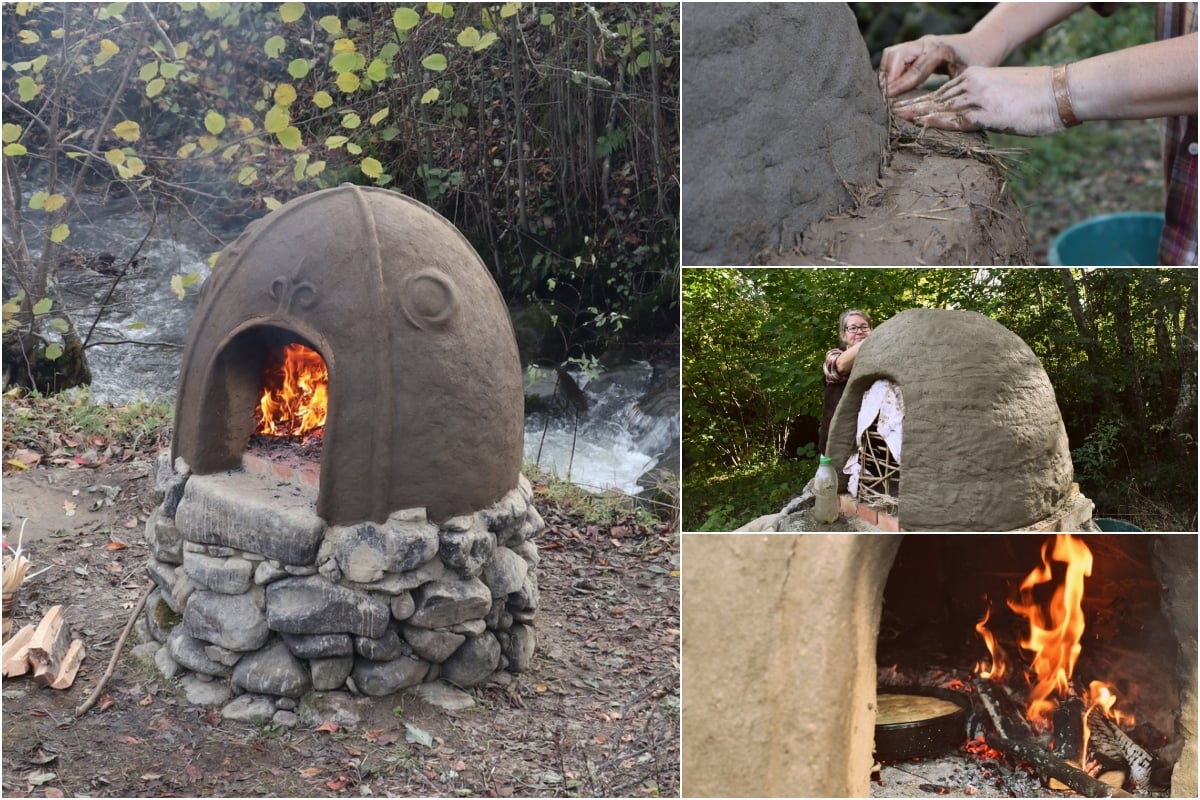
So, this isn't a #Kiln (it is only spec'ed to 700 F), it could be useful for cooking food. How To Build Your Own #CobOven – Step-by-Step Written by Author Cheryl Magyar Published on February 27, 2024 Excerpt: "earth ovens work – and bake well – because the heat generated by burning wood is absorbed into the thermal layer of the oven. Then that radiant heat is evenly released through the air, while conduction (from the contact of the bread dough on the hot bricks) and convection (hot rising air) play a part in the thorough baking process too. But why would you want to build an earth oven when you already have a place to bake in your kitchen? Well, you might want to build a cob oven because: it has the chance to become the centerpiece of your outdoor living space – where family and friends gather to eat well, laugh and create long-lasting memories in nature. clay is an abundant material to work with. the wood you burn can be sourced locally, plus it’s renewable. cob ovens are a low-impact alternative to gas or charcoal. it gives you the chance to apply your artistic and creative abilities to a functional object. it promotes self-reliance – you still get to bake, even if the power is out for a prolonged period of time. food cooked in cob ovens tastes better, you’ll have to try it to find out. you love pizza, or bread, or baked meat." Learn more: #SolarPunkSunday #DIY #Homesteading #TraditionalTechnology #EarthOvens #WoodFiredOvens #AncientTechnologies #NaturalBuildingMaterials
#Wikihow - How to Make a #BrickKiln Guide to making and using an easy #DIY brick kiln for firing #pottery Co-authored by Tony Hoang Last Updated: March 26, 2024 "Brick kilns have been used for thousands of years to create pottery, tiles, and other common objects. Whether of simple or complex design, all brick kilns use a wood fire to harden objects inside. You can easily make brick kilns once you’ve determined the needed dimensions and identified a flat clear area outdoors. By laying brick to build the kiln’s walls and covering it with a piece of iron or ceramic fiber for its roof, you can start firing your own pottery in no time." #SolarPunkSunday #WoodFiredKiln #DIY #Kilns #Homesteading #Pottery #Quicklime #BackyardKilns #TraditionalTechnology
Ahhhh... Using a hand-drill to start a fire. Now that takes me back to my days at the Wilderness School! I'd love to try and make a pottery-kiln (I'll be researching that soon...) #Australia - Making #lime with Primitive Technology "When heated above 840 degrees Celsius, the lime decomposes into calcium oxide (CaO) or #Quicklime and releases carbon dioxide (CO2). When water is added to the quicklime it becomes calcium hydroxide Ca (OH)2 or #LimePutty. From here the calcium hydroxide can then be shaped into a form and allowed to set. Carbon dioxide enters the lime putty as it dries causing it to turn back into calcium carbonate. The new calcium carbonate has then set, remaining solid and water resistant. In my local geography, calcareous rocks such as limestone are absent leading to a difficulty in acquiring the feed stock for lime making. However, I was still able to make lime by collecting the shells of large terrestrial snails that are native to the rainforest here. The unoccupied shells of these snails were gathered up and stored at the hut. Fire wood was gathered and packed neatly into the kiln. Importantly, the firewood was stacked on top of the grate rather than underneath it in the firebox as is the normal procedure for firing pottery. Using an ordinary updraft pottery kiln in this configuration allows it to reach much higher temperatures than would be possible during normal use. The wood was lit from above and the fire burned down towards the grate. Alternate layers of shells and wood were added on to this burning fuel bed. After adding the last layer of wood to act as a 'lid' to prevent heat loss from above I left the kiln to finish on its own, unsupervised. The whole process took about an hour and a half. When the kiln had cooled down a few hours later, I took out the calcined shells. Not shown in the video was the fact that some shells got so hot, the dirt stuck to them turned into slag and fused to them, possibly with the lime acting a flux lowering its melting point. This extreme heat (+1200 c) should be avoided as the over burnt lime becomes 'dead lime', unable to slake in water. Most shells were still useable though. They were taken out of the kiln and had water added to them. An exothermic reaction then ensued. Heat was produced as the lime quicklime turned into slaked lime. The water heated up creating steam and the shells decomposed into a white paste. The paste was stirred and crushed pottery was added to it as an aggregate (sand is normally used for this, I just had a lot of old pot sherds lying about to dispose of). This lime mortar mixture was then formed into a block shape and left to dry. It took about a week and a half to set as we have had extremely humid, wet weather. The block was observed to have set demonstrating its properties. What I created is actually lime mortar, typically used for mortaring bricks and tiles together. It’s basically the ‘Glue’ that holds together the building blocks of masonry structures. From my research 20 kg of lime mortar is used on a 1 m square section of brick wall. 5 kg of lime to 15 kg of aggregate (sand, grog etc.) per a 1 m square section of bricks. The shells, though large, are not terribly abundant. A method for finding shells efficiently needs to be made before considering making lime mortar in this fashion. From my experience sand bars in a creek sometimes accumulate snail shells from higher up in the mountains. In these spots, water velocity decreases and shells in the water tend to drop out of the water column. Additionally lime may be partially replaced with ordinary wood ash in mortar without a corresponding decrease in strength. To conclude, making lime in a land without limestone is possible but can be problematic when trying to do so on a large scale." Watch: YT: Wordpress: Patreon page: https://www.patreon.com/user?u=2945881 #SolarPunkSunday #SustainableMaterials #TraditionalTechnology #ZeroWaste #Mortar #LimeMortar #Snailshells #Adaptation #AncientTechnologies #Science #AnimalProducts #LocalMaterials
I use eggshells as a soil enhancer. I also sterilize the shells (300 F for 30 minutes) before grinding them into a fine powder (using a mortar and pestle). Using #Eggshells as #Lime in #Soils Cracking the Code: Can Ground Eggshells be Used as a Liming Source? April 2, 2025 by Leon Martinez Excerpt: "Factors Affecting Eggshell Liming Efficacy The efficacy of eggshell liming depends on several factors, including: - Particle size: Finely ground eggshells are more effective at raising soil pH than coarsely ground eggshells. - Application rate: The amount of eggshells applied to the soil can impact their effectiveness as a liming source. - Soil type: Eggshell liming may be more effective in certain soil types, such as acidic soils with low calcium content. Practical Applications of Eggshell Liming If you’re interested in trying eggshell liming, here are some practical tips to get you started: - Collect and dry eggshells: Collect eggshells from your kitchen or local farms and dry them thoroughly to prevent mold and bacterial growth. - Grind eggshells: Grind the dried eggshells into a fine powder using a coffee grinder or mortar and pestle. - Apply eggshells to soil: Mix the ground eggshells into the soil at a rate of 1-2 cups per 10 square feet. Conclusion While ground eggshells show promise as a liming source, their effectiveness depends on several factors, including particle size, application rate, and soil type. As with any liming material, it’s essential to monitor soil pH and adjust application rates accordingly. With proper use and application, ground eggshells can be a cost-effective, eco-friendly alternative to traditional liming materials." Read more: #SolarPunkSunday #SoilAddendum #Gardening #ZeroWaste #Reuse #SoilHealth #AnimalProducts
Wait, what...?!!! #Trump Is Exploiting the #Shutdown to Set Up Something Truly Terrifying By Dahlia Lithwick and Mark Joseph Stern Oct 17, 2025 Excerpt: "I think that is a dangerous thing, and it’s pretty much undeniable that Trump has just crossed yet another Rubicon. He has already asserted presidential control over taxes through his tariff policy. He has asserted control over the Federal Reserve and interest rates and monetary policy. And now he’s asserting control over appropriations—and not just through pocket rescissions or canceling projects in blue states, which he had already done. Now he is actually asserting a constitutional imperative to spend money in a way that Congress has not approved. When you combine all of those things, it’s hard to see how the separation of powers still exists in this country." Read more: Archived version: https://archive.ph/7cYI5 #USPol #TrumpIsAFascist #SecretPolice #CapitolGuards #Panem #authoritarianism #Fascism #CharacteristicsOfFascism
#Indiana reports #AvianInfluenza cases in wild birds in 3 counties by: Gregg Montgomery Posted: Oct 18, 2025 / 11:29 AM EST / Updated: Oct 19, 2025 / 10:42 AM EST INDIANAPOLIS (WISH) — "#BirdFlu has been found in a #WildDuck and #vultures in Indiana, the Department of Natural Resources said in a news release issued Friday. "The announcement comes after avian influenza was found earlier this month at five commercial #duck farms in northern Indiana. "Natural Resources says bird flu has been found in a #BlueWingedTeal in Greene County in southwest central Indiana, and in death black vultures in Jefferson County in southern Indiana. The virus is also suspected in similar cases involving dead #BlackVultures in Franklin County in southeast central Indiana. "The U.S. Department of Agriculture Wildlife Services and the state’s department recorded the finds. "Signs of bird flu in waterfowl and raptors include sudden death; neurological impairment such as lack of coordination and tremors; a lack of energy and appetite; swelling of the head, neck, and eyes; nasal discharge; cough; sneezing; and diarrhea. "The U.S. Centers for Disease Control and Prevention believes the public health risk from bird flu is low, but humans can contract the virus. People are advised to avoid contact with sick #waterfowl and other wildlife. If handling a carcass is necessary, Natural Resources recommended the use of disposable gloves and a mask, and double bagging the carcass, and washing hands thoroughly afterward. "The U.S. Fish and Wildlife Service recommends that waterfowl hunters process birds in a well-ventilated area or outdoors and wear protective clothing such as a face mask and gloves. Meat harvested from waterfowl should be cooked to an internal temperature of 165 degrees F before consumption. "The Indiana Department of Health advises individuals to contact them if they develop symptoms such as eye irritation, fever, cough, or other flu-like symptoms after contact with waterfowl. They can be reached at 317-233-7125 during business hours or 317-233-1325 after hours. "Because domestic and agricultural animals — including poultry, cattle, and cats — are also susceptible to avian influenza, it is recommended to process and dispose of harvested waterfowl away from these animals and practice good #biosecurity measures." Source: #HPAINews #BirdFlu #AvianInfluenza #CatHealth #AnimalHealth #HealthAndSafety