Homepage - An Open Source Self-Hosted Dashboard Homepage is a modern, fully static, fast, secure fully proxied, highly customizable application dashboard with integrations for over 100 services and translations into multiple languages. Easily configured via YAML files or through docker label discovery. With features like quick search, bookmarks, weather support, a wide range of integrations and widgets, an elegant and modern design, and a focus on performance, Homepage is your ideal start to the day and a handy companion throughout it. My video explains why I moved from Heimdall to Homepage. It also shows what various service and information widgets are available, what my dashboard looks like, what the various parts do, and how the configuration files work. My docker compose file is also unpacked. Watch #technology #selfhosted #opensource #dashboard
Various desktop Linux tips for newbies I'm also seeing more and more new Linux users popping up. They're noticeable for often saying "why did they not do this earlier". The point is, today's Linux is very different from 20+ years ago. It generally just installs and works, often looking very similar to what users experienced before (meaning basically everything can be done in the graphical menus and windows). Linux gets a bit more interesting if you venture into using the AUR or Git versions of apps (you have to enable this, as these are more bleeding edge). This is where dependencies may break, and you need a bit of terminal skill often to fix things, but the good news is, you're not losing any data. Over the years I've also opted to having all my user data (the stuff under /home) in its own partition so that is it fully separate from the main OS. The reason was in the early years I used to format the drive and do clean installs, or was distro hopping. Nowadays, I just use Manjaro KDE, and it just keeps updating all then time - have not reinstalled for many years now (and no nagging to activate it or end of life coming). You may wonder what happens if a distro is no longer supported? Well firstly it keeps working, and it may well still pull some patches and updates. But usually you will be able to migrate to using some other distro, and your user data all stays intact. But this is also a good reason for picking one of the many mainstream distros, that should be around still for a very long time (measuring that long time in terms of Windows release cycles). No-one has to move to Linux, but for those curious enough to want to find out more, the usual approach is to start with a liveboot version and just run it from a USB stick or external drive to test it out a bit. The next step is typically to install it side-by-side with Windows, but I'd really recommend a separate hard drive, as Windows does some odd things to the boot partition sometimes. Linux can access the user data on a Windows drive, but I'd be careful with that, as Windows can lock the drive if it uses hibernation mode. The point is, lots of things are possible for Linux. One will find of course that many companies only bring out their software for Windows and macOS. And example is Stream Deck. But I discovered two excellent 3rd party apps that work even better under Linux with Stream Deck. Da Vinci Resolve for example produces world-class video editing software that runs on Linux natively, but there is also Kdenlive that will work just as well for most users. So always do a bit of research before buying software or hardware to choose wisely. Personally, for me, it's more about the freedom to what I want with it. See #technology #Linux #opensource
Using Signal groups for activism "Things are heating up. Millions of people are taking to the streets against Trump's rising authoritarianism. Communities around the US are organizing to defend against ICE raids, to protest Israeli genocide, for mutual aid, and for other forms of fighting fascism. Signal can help people safely organize in all of these contexts. Signal groups, in particular, are more powerful than you might be aware of, even if you already use them all the time. In the linked post you'll see how." Of course, activism is also about a much wider range of topics than the above, and many have been running for decades. Apart from activism in 1st Word Countries, there is also activism in many 3rd World Countries, which in many cases are really life and death situations if users are caught. Signal is not THE most private network around. There are many others like Threema (not public link group invites though) and SimpleX (really open group invites with custom names per group) that enable far more anonymity. In other words, they don't require any form of registration or a mobile number to work, meaning there is even less to link back to any individual user. But this is why I wanted to make this post. It often comes back to many people wanting to find their friends on their chat app. Yes, finding friends makes communicating easier, but that in itself does leak metadata. The reason I only have two or three contacts on Threema and SimpleX are that it is way more difficult to build out your network. This is where Signal does strike an excellent middle path - it is simpler to use and find friends, whilst also going as far as it can to guard your privacy. It has some good group options (including an announcements only group) and most importantly where it differs from WhatsApp and Telegram, are that it's metadata cannot be accessed by Signal (WhatsApp goes as far as actively sharing users metadata with advertisers and partners, which is why WhatsApp has so many businesses on board). Telegram may handle far bigger numbers for its groups, but the problem is users do need to set up their privacy settings very carefully, and their metadata is at the risk of being subpoenaed now, and of course Telegram's encryption is proprietary. Signal's groups are limited to 1,000 users, and another issue may be that there is one profile across all groups (unlike SimpleX where you choose a name for each group you belong to, but it does not scale well to large groups at all). Signal does hit a sweet spot though and should really be adopted by a lot more mainstream users. Signal's user privacy is way ahead of both WhatsApp and Telegram, yet it is just as easy and intuitive to use. But, as I mentioned above Signal is not perfect. To summarise those shortcomings, they are: 1. Even announcement-only groups are limited to 1,000 users (Telegram has 200,000 for normal groups and unlimited users for broadcast groups). 2. A phone number is required to register the account initially (SimpleX and Threema do not require anything). 3. The profile your friends see is the same profile seen in a group (SimpleX allows different names) so select your profile name with this in mind, although the phone number is hidden by default. See #technology #privacy #chatapps #activism
How to Clear RAM Cache, Buffers, and Swap in Linux Without Reboot "Like any other operating system, GNU/Linux has implemented memory management efficiently and even more than that. However, if any process is eating away your memory and you want to clear it, Linux provides a way to flush or clear the RAM cache. In general, it is not a good idea to manually free up Buffer and Cache in Linux which might be used by the Linux kernel, which is designed to manage these resources efficiently, and manually clearing them can disrupt system performance." So, you can choose to apply any of these commands, and they won't do any harm, but the closing thought is that you should not normally really need to do so. Linux will use available RAM anyway so do not think that if it only uses 20% of RAM that is better than 80%. See #technology #Linux #opensource
If you find OpenStreetMap a bit difficult to plan off-road routes, try OpenRouteService OpenRouteService (ORS) is an open source route planner service that leverages OpenStreetMap data to provide a variety of routing and spatial analysis services. It actually uses a forked and modified version of the GraphHopper routing engine (another option that can be used, and which is present inside OpenStreetMap as a routing alternative). I was trying to plan a 4x4 trail between two places, but was finding that OpenStreetMap was routing me via a gravel road I did not want to follow. OSM also only has one export format which is GeoJSON. Switching to GrassHopper within OSM did actually help choose the correct route, but then I found OpenRouteService. ORS has quite a few more options for adding and moving waypoints which allows you to more precisely plan your route. It also have 5 different export options including Standard GPX which I wanted. It allows a maximum speed to be set too, but sadly the minimum is 80km/h where I'd prefer to have set it to 50km/h for the route I was taking (still I can just mentally adjust the time). Interestingly too, you can deploy it yourself using Docker, with a Docker Compose file. Once you can your route, you can import that into any other navigation app, and use that in your vehicle. See #technology #opensource #navigation #openstreetmap image
Proton's New AI Assistant Lumo Offers a Private and Encrypted Chat Alternative On the plus side (not the Plus plan) this is an AI assistant that promises to keep your conversations completely private, even for the free version. "Proton says Lumo doesn't keep chat logs on its servers, and everything stays encrypted on your device using the same technology that protects the company's other services, so no one else can read your conversations – including Proton itself." On the not so Plus side, there is a Plus version, but it appears that Proton "Unlimited" plan subscribers, like myself, are limited to the free version only. Which is OK, but it may be time to reconsider that naming of that plan as it is getting further and further away from "unlimited". Some quick comparisons by running through some queries I already did in Perplexity is leaving me with a feeling that it is not as intuitive as Perplexy in terms of interpreting my actual question, and the answers are a bit more vague versus Perplexity's. It does however also provide sources for its answers (not all though). And of course a Proton subscriber, I don't get anything extra on the AI. So, I'm a little mixed on this one, but I suppose its privacy first focus may be plus for many. See #technology #AI #privacy
I'm finally able to use Wayland on an ongoing basis It was the need for Waydroid only working under only Wayland, that forced me to again have another go at Wayland this week on my Manjaro KDE Plasma. Yet again I hit some issues, one or two of which were show-stoppers, but I have finally overcome them, and although there are some irritations, they are now pretty minor, and I have workarounds to make everything work now. These were all issues that made Wayland feel, for me, it was not quite ready for full prime time. Key for me was to be sure that: * Steam games worked * KMyMoney finance app worked * My hundreds of shortcuts in Steam Deck worked * OBS Studio worked * VLC Media player worked * Wayland was stable without intermittent crashes I suspect that XWayland has largely been the reason everything now seems so much better. For KMyMoney I had long since sorted out that if I added the environment variable "QT_QPA_PLATFORM=xcb", this sorted out the non-display of the application. This may even not be needed any more. My biggest challenge had been to find alternatives to the excellent xdotool utility, which I use extensively in Bitfocus Companion for my hundred plus productivity shortcuts. Not only is xdotool exclusively for X11, but it is really easy to use as it uses the key names such as Enter, Space, etc. Yes there is ydotool, but it is really difficult to do set up say 'xdotool key Ctrl_L+f' in ydotool as this must be 'ydotool key 29:1 33:1 33:0 29:0' and just don't dare forget one of the key up sequences otherwise it will all break. I started looking into dotool this week as well as other options. Nothing beats xdotool for simplicity of use. I'm not sure why or when, but I tested out an existing xdotool shortcut... and it just worked! Wow, OK so this must be some XWayland improvement. This made me very happy, as converting everything to ydotool would be pain times 100. Wayland still has its 'security' limitations on insertions into keyboard/mouse input, so I do sometimes get a popup that I must accept, but it works! Wayland also does not like keystrokes to be inserted into background windows, but I see there is now an application called Kdotool which I must still explore. The other irritation was not being able to resize application windows. Normally, I'd move the mouse cursor to any corner of an app and then drag it bigger or smaller. Wayland was just not allowing this to happen. So what I've discovered to make this happen is two things: One can hold down the Meta key and then hold the right mouse button near that corner, and then do the usual resizing quite quickly. How will I remember the key combination? Well with my Stream Deck, as I now have a key mapped to hold the Meta key down, and reminds me to right-click the mouse. The other thing I discovered was, resizing does sort of work if you have extremely fine motor skills. You have to position the mouse about a pixel outside the corner of an app, and then you can grab and resize it like 'normal'. If you do this on the corner or just inside the app, it does not work. So the issue seems to be that the resize handle area is extremely small. I've looked inside the window theme settings and cannot seem to see anything that would make this larger. Yes, I know there is a setting called 'Enable extended resize handles' and I have that ticked already. There is also a window menu that has an option for resizing, but that is too clunky to use, so the above two workarounds see m to work OK for me for now. Another thing was my mouse cursor 'sticking' as it moved across screen one to two, and from two to three. It only happens when I move it fairly slowly. Turns out this is a feature for those not wanting to go past the screen edges. But there is a setting not only to adjust the stickiness, but also to disable that. So sorted too. I have some open apps that show blank icons in the toolbar. This is not too serious, as if I hover the mouse cursor over them, their preview shows what they are. For now too, it is only my Joplin notes app that does this under Wayland. OBS Studio works as-is. The only issue seemed to be the screen to capture. It is a super easy fix, but must be reversed if you ever use X11 again. Basically I had to just add a new screen capture and I think its properties were for Pipewire capture or something like that. Everything else worked as before. The last thing that was broken, was VLC media player was giving codec errors on playback. The short of it was I just needed to install additional codec plugins (not sure why, as it all worked as-is on X11). Or one can also install the Flatpak version of VLC and that works out of the box (or is that inside the container?). Other media players like MPV just worked as normal without any changes. Some screenrecorders, like Vokoscreen will work, but they lose their ability to record only a window or a rectangular area, as they are X11 specific. OBS Studio can do the job, but I also installed Kooha which does do rectangular areas under Wayland. I've now been using Wayland for two and a bit days. No need yet to go back into X11 to do anything, and Wayland has been stable so far. I've tried two games under Steam Games, and they are working, and my Stream Deck shortcuts for those games are also working fine. Very ironically, the Waydroid app is not starting after the second day. It was the reason for me re-trying Wayland again. But that is not really a Wayland issue itself. It looks like I'm now fully moved over to Wayland, and my mind is at rest, at least for the showstoppers I had before with it. image #technology #Linux #opensource #Wayland

Harper is a grammar checker that is on-device and open source "When it comes to grammar checking, Grammarly is the premium tool for it. It's a proprietary tool and it was among the first one to make a mark as a web-based Grammar checking tool. Then there is LanguageTool that is/was open source, made in Germany and offers hosted service for free or for a price (you get additional features). LanguageTool was acquired a couple of years back and since then it's privacy policy has changed as it processes data on US servers, instead of European ones." I'm trying out Harper and although it works fine, it is a very new product (less than a year old), so there are some improvements that can be made. For example, I'd like to see auto-correction rules we can add ourselves for whenever I type teh to be changed to the. But it is being updated regularly I see. Right now too it only supports English (but being open source I think that will change soon). It has plugins for Firefox, Chrome, Obsidian, WordPress, and it can be integrated into various code editors as well as into JavaScript/TypeScript/Rust codebases. There are no mobile apps as the view is that most keyboards have their own built-in spell and grammar checkers. But the privacy-first approach does mean no data going into someone's cloud, and does mean also better speed and even working offline. That would also mean right now no syncing of personal dictionaries across devices, but I'm sure that can be added in time to use Nextcloud, Dropbox, and other personal cloud services. See and GitHub site at #technology #opensource #spellchecker #privacy
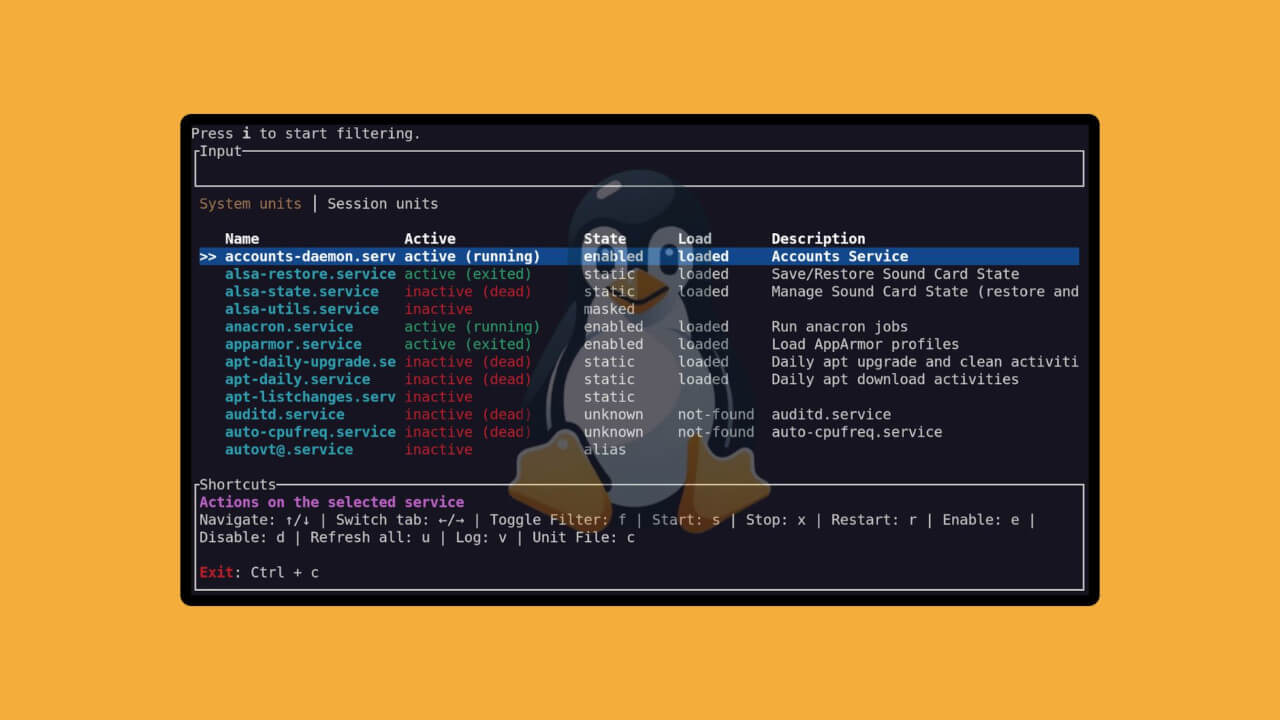
Manage Linux Systemd Services Easily With Systemd-manager-tui "Managing services on a Linux system often means typing long systemctl commands or digging through logs with journalctl. But what if you could do all that from a single, easy-to-use terminal interface? That’s where systemd-manager-tui comes in." Well, now I know what a TUI is! A terminal User Interface... But this is a nice app not only to browse through all your systemd services and see which are active, dead, disabled, etc. It will also allow you to easily restart, stop, enable, disable those services, view logs, and even view and edit the unit files from inside this TUI view. I discovered some services I installed a long time ago and no longer use, so I could do some clean up. Although I had to go delete the unit files from outside the TUI. See #technology #Linux #opensource #systemd
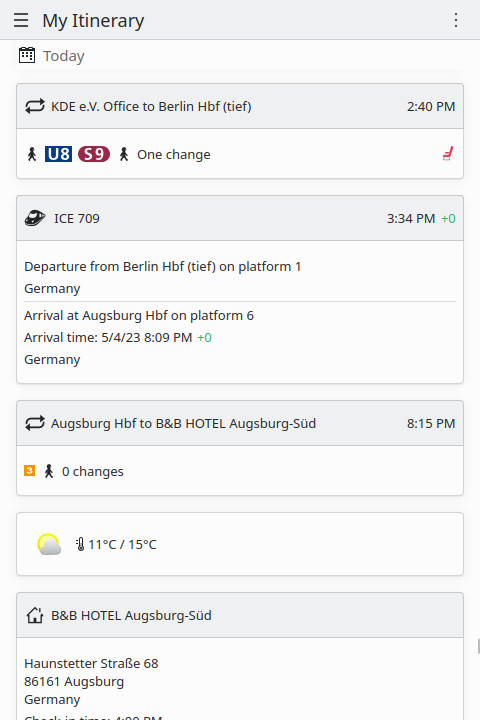
KDE Itinerary is a digital travel assistant with a priority on protecting your privacy This is an open source Linux and Android app, that syncs between devices using services such as KDE Connect, Nextcloud, or DavDroid. It does itinerary planning for various modes of transport and accommodation booking, complete with map views, boarding passes, train coach layouts, etc. It can even do real-time delay and platform change information for trains, and give weather forecasts for destinations along your trip (services permitting, I imagine). The focus is on privacy, though, so this does not seem to be a travel sharing app that shows photos etc. See #technology #opensource #travel