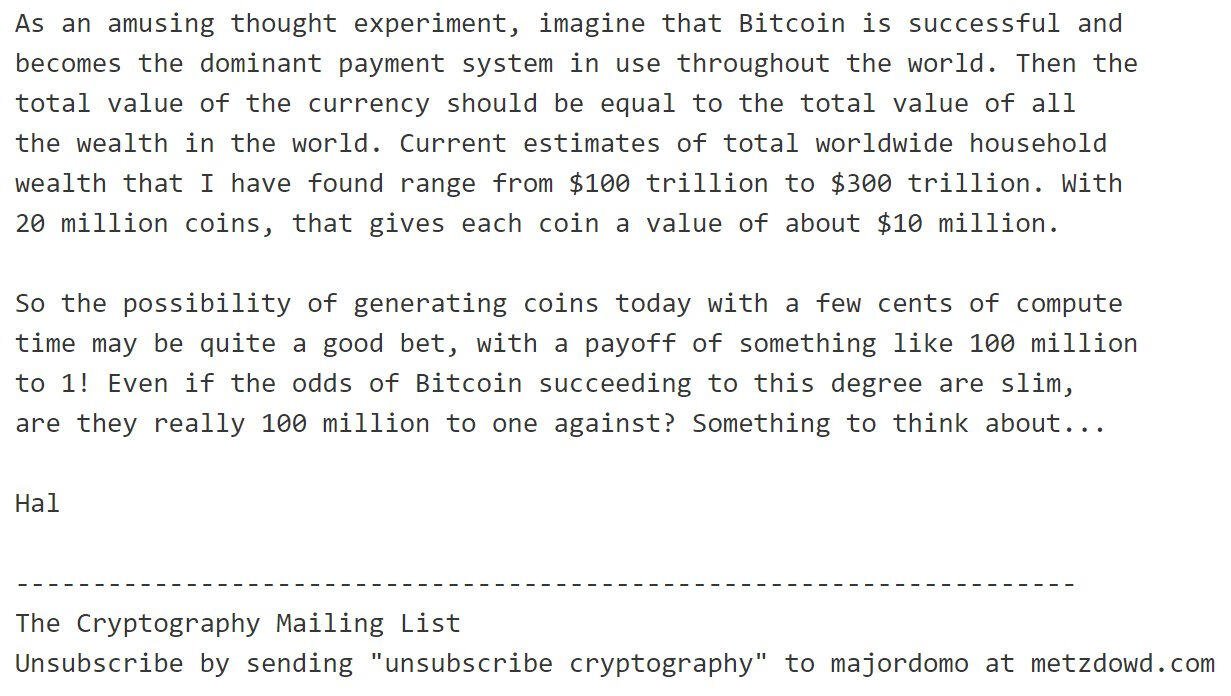
It is nice, but not relly the right way to think about it. The purchasing power of money does NOT equal to market cap of everything divided by total units of currency, but from supply and demand for money, that is demand for holding the units of currency (desire to hodl).
To ilustrate, imagine a world where bitcoin is universal money, and everyone has a desire to have 5% of their net worth in BTC. Now immagine world where it's 25%. Massive difference. It works like all other market prices.
Note that 25% in money is crazy high in a world, where bitcoin has become stable hard money, and is not going to the moon anymore. In Hal's argument the number would be 50%!
Thank you for this analysis, I’m thinking along the same line but can’t quite grasp the conclusion.
Would Bitcoin market cap effectively float alongside that of every other asset class in proportion to how much people want to hold them?
But if there was no fiat, a fixed supply asset like BTC is the defacto go between liquidity for all other asset classes.
I can see that during the transition of Bitcoin adoption the value will go up, but the end state is much more difficult to see.
Assume the end state of total Bitcoin adoption and no fiat. How is value growth achieved in say a stock when any BTC going into it also devalues the BTC itself, which the stock is valued in. What?!
End state would be an economy where everything is priced in BTC. Even the market cap numbers would be show in BTC. So market cap of Bitcoin would be 21M. Prices of goods on the market would be in BTC. Instead of never ending inflation, you would see prices reflecting the market conditions more acurately, without distortions caused by creation of new currency units.
"BTC going into a stock" just means that an exchange took place. One guy exchanged units of stock for another guy's BTC. Stocks can increase in value if investors think it is doing well as a bussiness. Then they are willing to buy for higher price.