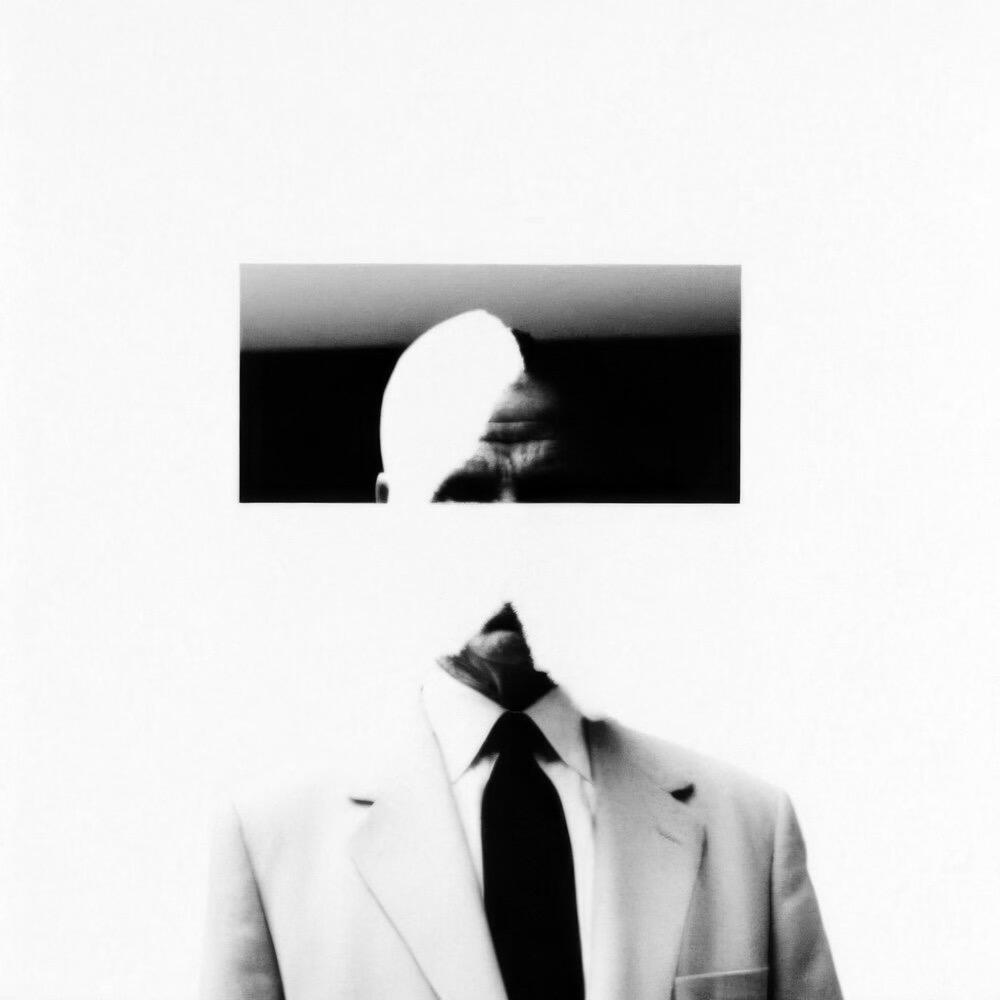

The art of the pilgrimage is scarce in the age of the plane, train, and automobile.
To go on a pilgrimage is to remove yourself from your typical environment, and therefore, your typical identity. The destination should be significant, if not to anyone else, at least to you. The journey should be long, longer than ninety-nine out of every hundred.
My last pilgrimage was to Los Alamos.
I left Saint Louis at five in the morning. Winter’s first snow caused me to miss my connecting flight, a welcome delay, since my wife was in the connecting city at the time. After Thanksgiving leftovers and a first watch of Cloud Atlas, a film about how small acts ripple across centuries in ways their actors never see, she drove me back to the airport for an evening flight to Albuquerque.
I picked up my rental car around seven and started the two-hour drive into the desert and up to the mesa.
Winding up the mountain into town, I stopped at a scenic pulloff to look at the stars. I stepped out of the car and faced the dark desert horizon. The sky was filled with them from lack of light pollution. I later learned the spot was called Anderson Overlook. I would return the next day.
Winter is cold here despite what the high desert surroundings suggest. I got back in the car and continued to my hotel.
Checked in but restless, I walked to Ashley Pond, the focal point of the town around which the laboratory grew. Just north of it stands Fuller Lodge, where a bronze statue of Oppenheimer and General Groves waits for pilgrims like me.
Oppie holds a pipe, not the more usual cigarette. Groves clutches a rolled set of plans, his tie tucked into his shirt the way military men do. I stood across from them for a while, judging every detail and proportion until I got cold.
I started east toward the main strip but quickly stopped, startled by a buck headed toward no fewer than twelve other deer, bedded down in the grass beside the lodge. Despite the cold, I took a seat on a nearby bench and watched them watching me, one party more cautiously than the other. It was me. They had strength in numbers, and knew it.
I envied them for a moment, until I didn’t.
I returned to my room and read a chapter of John McPhee’s The Curve of Binding Energy, before turning in at around eleven.
On Sunday morning I enjoyed my hotel waffle with some orange juice while eavesdropping on a couple switching between English and Spanish about concert tickets. Then I was off to Bandelier National Monument to see the Puebloan cliff dwellings.
The drive took me past the modern Los Alamos National Laboratory for the first time, the inheritor of everything that started here eighty years ago. Then, around a bend, the ancient canyon opened up.
The Puebloans built their homes into these cliffs sometime around the twelfth century. They farmed the canyon floor, raised children in stone nooks, watched the same sunsets I’d come to watch, and then, sometime in the sixteenth century, they left. Drought, maybe. Resource depletion. We don’t fully know. The civilization simply ended, and the desert held its ruins quietly for four hundred years until Anglo ranchers stumbled across them.
I made my way up the rocks in a caterpillar formation behind a Chinese family, them inching ahead to the next photo opportunity while I stopped to absorb where they’d just moved on from. Each time our caterpillar’s back arched, they asked me to photograph the whole family. I obliged, and they carried on.
At the top of the main loop, I climbed into one of the home nooks to sit for a while. I closed my eyes for a few moments before remembering: meditating with your eyes closed is arrogant. So I opened them and let my vision blur, looking out from the nook across the canyon.
Back in town I took another few laps around Ashley Pond, before the least eventful but most thorough portion of my day: zig-zagging the entire town on foot from Bathtub Row into the modern sprawl.
All the while, I chain-smoked Japanese cigarettes a friend had picked up on a recent trip. I don’t smoke. My co-founder and I have a running joke about how much of history’s greatest science was done behind a whiteboard with cigarettes, so we once sought out the world’s least carcinogenic option. We looked no further than a top Reddit comment on r/Cigarettes from a user named postinga_fewtimes answering “What’s the healthiest cigarette out there? ”
I got in a full play through of Ludwig Göransson’s Oppenheimer soundtrack from the recent Nolan biopic. According to Spotify Wrapped this year, I am a top .2% global fan.
I thought the walk would feel more significant. Walking where those men and women walked, smoking and thinking about physics on the mesa. It felt lame, as it usually does when you do any substance alone and wait for profundity to arrive. Profundity doesn’t come when you’re performing it.
Later in the afternoon I googled where to watch the sunset. Anderson Overlook came up first. I knew before arriving it was the place I’d stopped the night before.
I pulled up forty minutes early, but it only took five to read Senator Anderson’s placard. The pulloff faced east, making for a poor sunset view, which was made worse by the ridge that rose high above this overlook on the other side of the road, blocking any view of the sun. As I looked across, I saw an old path leading up the ridge behind some barbed wire. I followed it.
The climb was docile. Tire tracks worn into rock, then a forking footpath once I crested high enough to see the sun lowering on the western side.
Here I found petroglyphs, the second set I’d seen that day, though far more recent than the Puebloans’. These were almost certainly carved by the boys of the Los Alamos Ranch School, which operated here before the Army took over, or perhaps by the Manhattan Project scientists themselves. Newer markings were present too, from decades of hikers. Where the Puebloans carved mostly symbols, these more contemporary carvings consisted mostly of names. The oldest I could identify with confidence: “TOM BORTON 1923.”
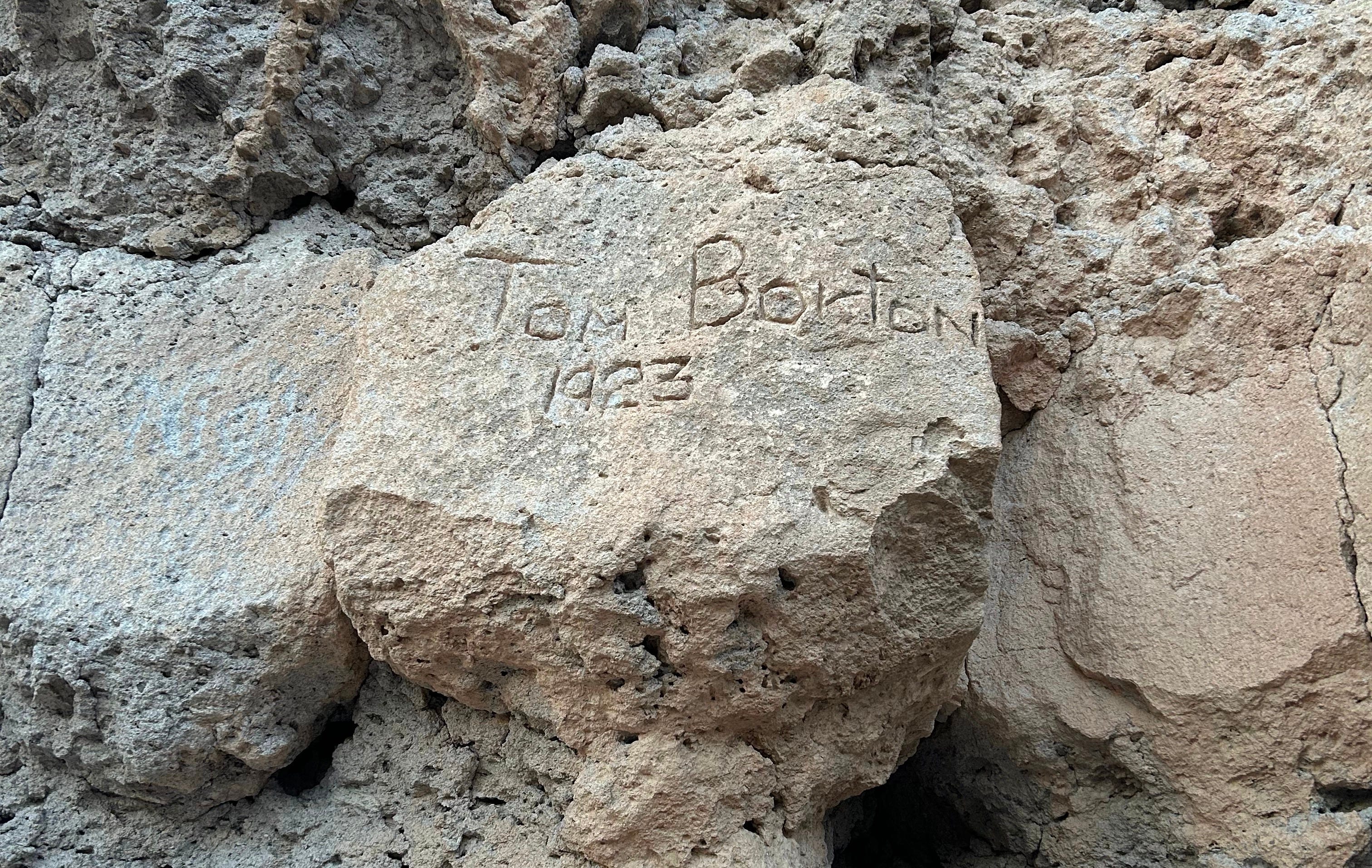
Everyone wants to leave proof they were here.
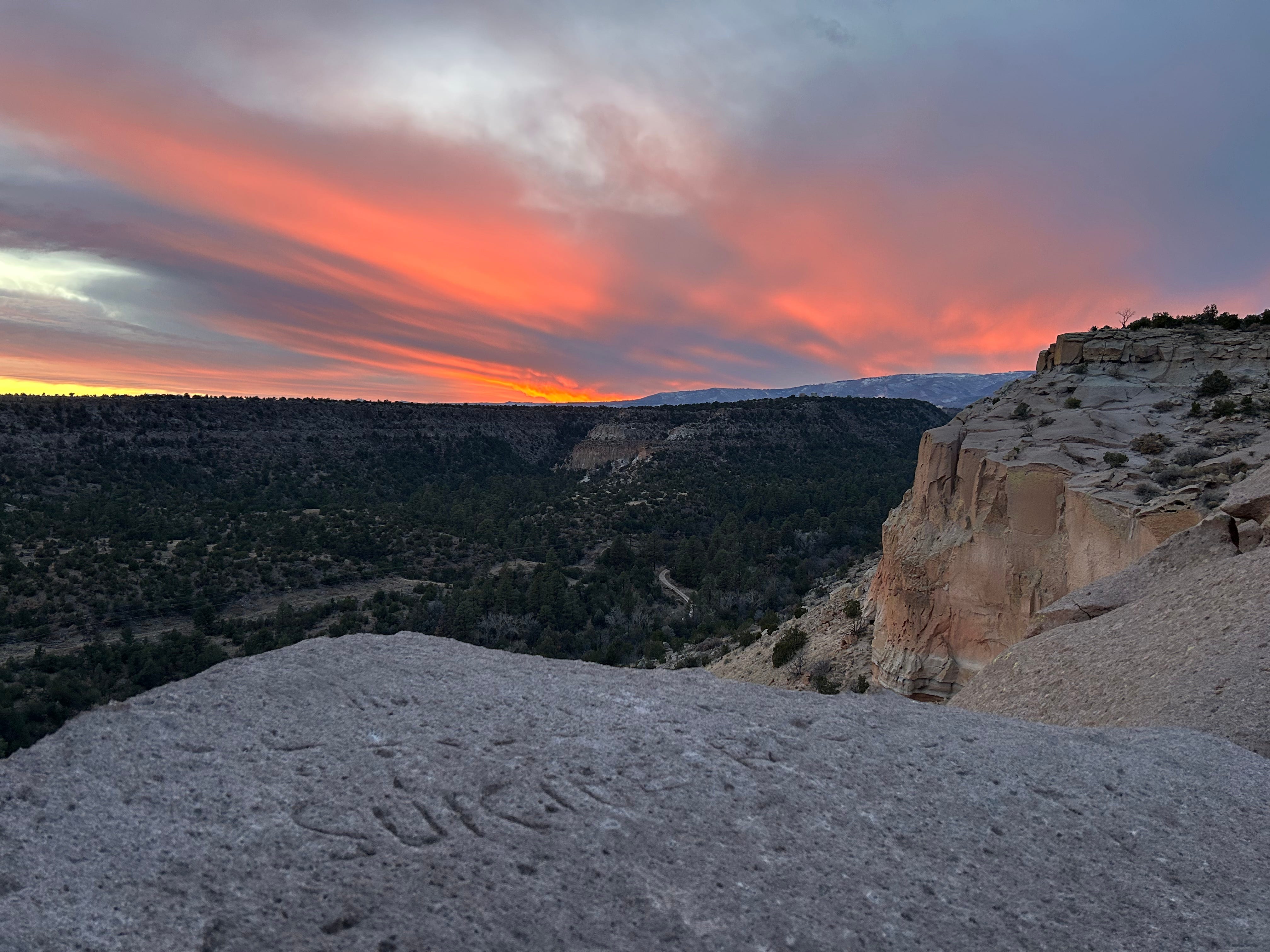
I continued to the top and made my way to a rock formation that jutted further out than any surrounding ledge. Carved into it: “SUICIDE ROCK.”
I stood at the edge and looked down. The drop was severe. I couldn’t help wondering if anyone had jumped. Then I looked up, and hoped that anyone who ever considered it had been confronted with a sunset like this one.
Writing this now, I’m compelled to share something from a conversation I’d have the following week with someone I love:
“A few times when it got hard, I thought about grabbing a rope and hanging myself. But then I thought—what a waste that would be, of the one life I’d been given. And I figured that at the absolute worst, I’d get to live this life seeing what it would be like to be a bum!”
There’s something in that I keep returning to. The floor beneath the floor. The freedom that comes from accepting you could lose everything and still find a way to live.
I turned to face east. A quarter mile across the plateau sat what looked like a bench, which seemed strange, for such a remote point. I walked toward it, feeling as though I was being watched the whole way.
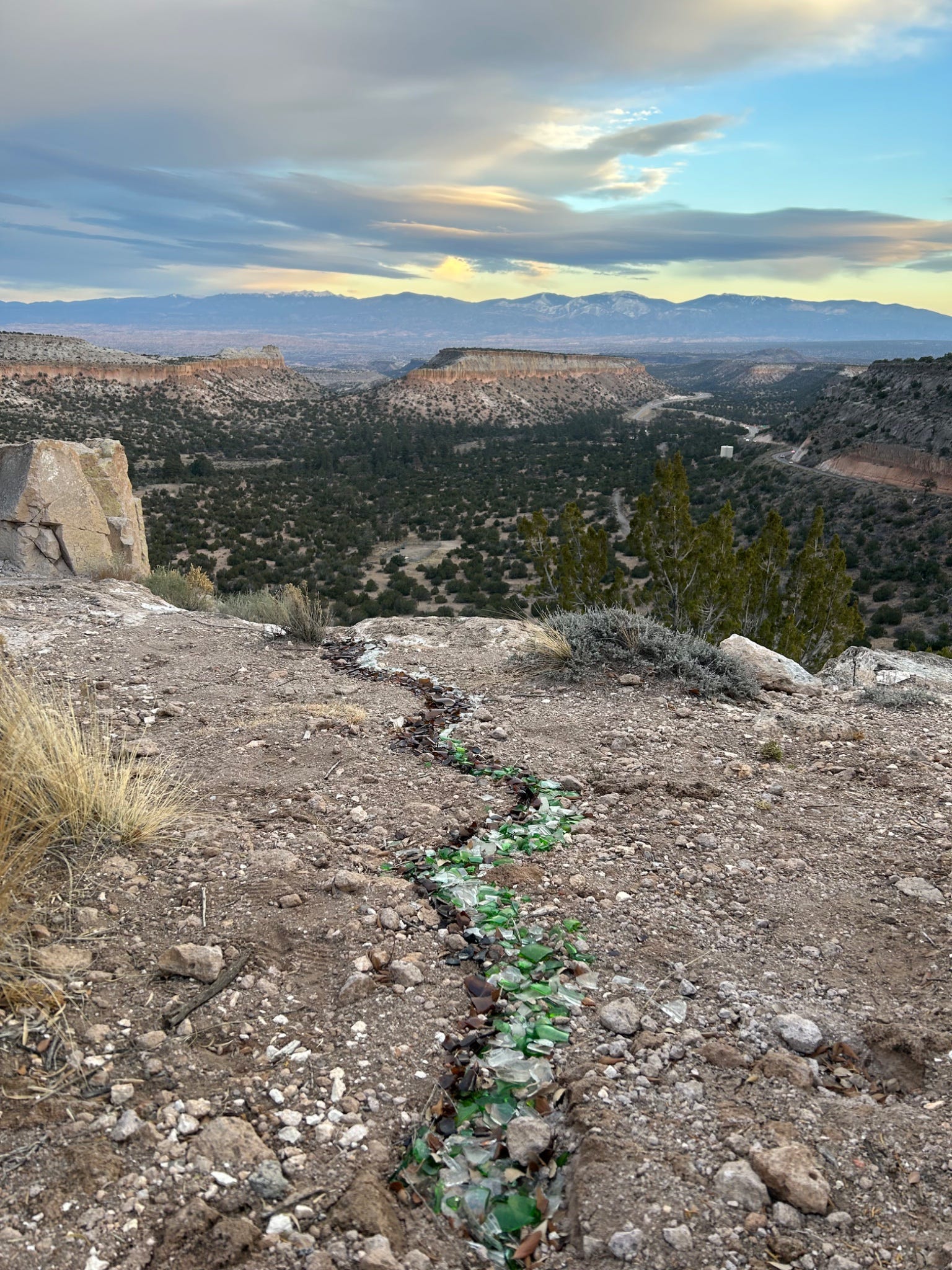
It was, in fact, a bench, with a small sign marking it as a “Meditation Point.” In front of it, someone had arranged a small river of glass bottle fragments, calling for attention in the last light.
I sat down.
One of my life’s goals is to develop a Los Alamos scale, distributed institution for advanced research, pointed not at destruction but at its opposite. At AION, my team and I work daily to bring aging under complete biomedical control. It’s a small but earnest start. I don’t know exactly how it will materialize, but the path is clearer than it was before I came here.
I’m not sure what I expected to find out there. I knew I wanted to see what it felt like to be in the place where a small group proved they could build something that mattered at civilizational scale. I wanted to know if the weight of that was visible anywhere, or if it had dissipated.
It hadn’t. It was everywhere. In the names carved into rock. In the glass river pointing nowhere. In the deer who grazed, untroubled, beside a statue of the men who gave us the power to unmake everything.
I sat until dark, then trekked my way back down to the car by the light of those many bright stars in the cold desert night.
Steganography is the art of hiding messages in plain sight. It can be a word, an image, a signal buried inside something that looks like something else. The term comes from the Greek for “covered writing.” It’s different from encryption in that the goal isn’t to make a message unreadable, but to hide the fact that a message exists at all.
The desert is full of it, perhaps because we are all looking for an oasis. Everyone out here is hiding something in plain sight, hoping the right person finds it.
-Benjamin Anderson
Nostr*: *ben@buildtall.com