The foundation of our metabolic health can be understood through three core pillars: light, water, and magnetism. These factors are essential for mitochondrial health, which drives our body’s ability to generate energy and resist disease. Light and water work together to power and regulate how our bodies produce and use energy. Magnetism, on the other hand, becomes a challenge in today’s world, where non-native EMFs disrupt the natural processes vital for energy production. Recognizing how these environmental influences shape mitochondrial function is key to understanding how we can protect and optimize our health in the modern world.
At its core, health is about our body’s ability to create and use energy to thrive. This energy comes from Adenosine Triphosphate (ATP), which is produced by the mitochondria and delivered to tissues throughout the body to power countless reactions. Interestingly, the structure of water surrounding these reaction sites may also act as a key catalyst, helping energy be used effectively. ATP itself is generated through the electron transport chain, a process where oxygen and electrons (prepared earlier by the Krebs cycle) combine to produce water, carbon dioxide (CO₂), and ATP. This entire process is known as cellular respiration.
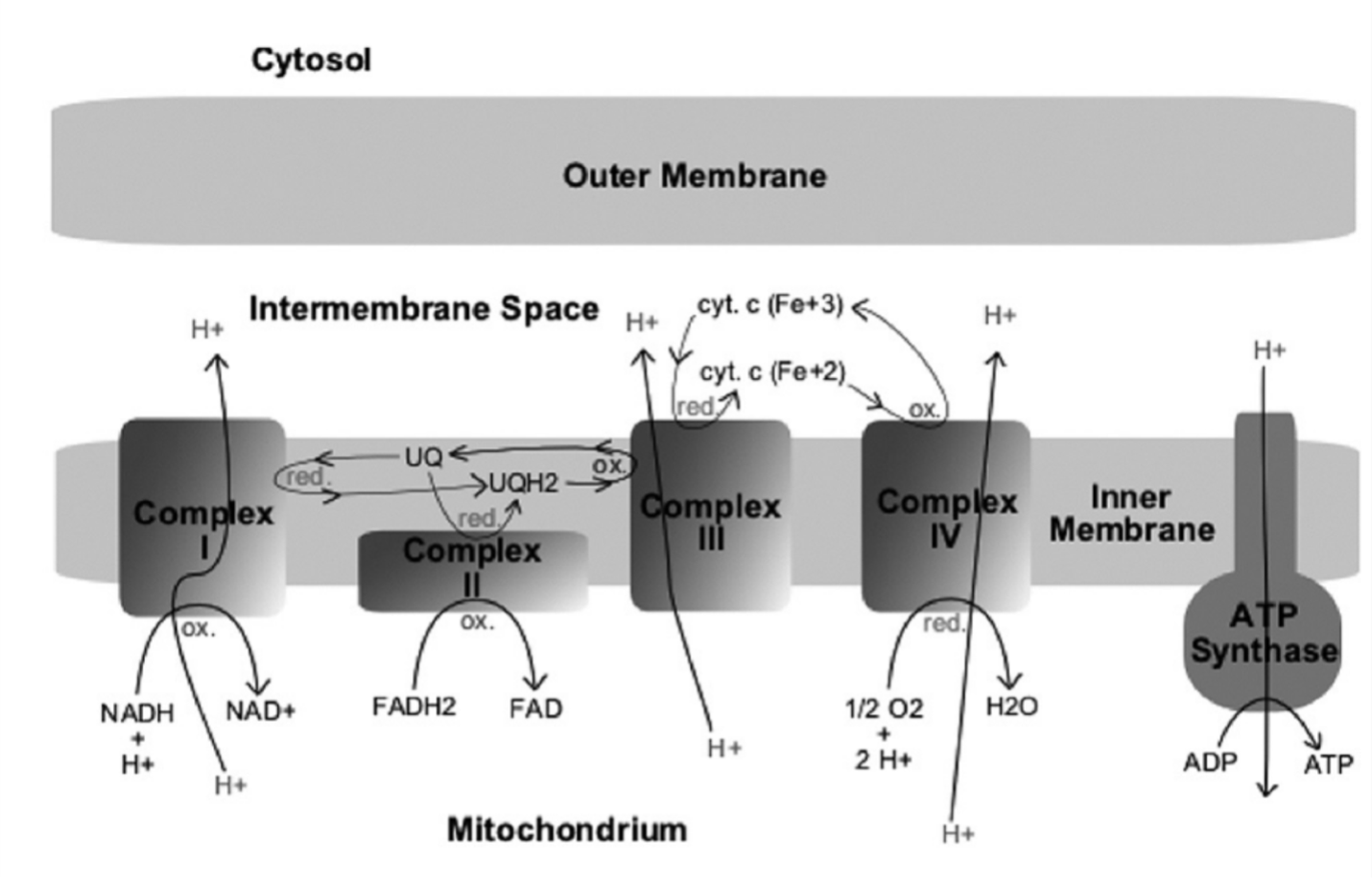
In cellular respiration, carbohydrates and fats are broken down into acetyl-CoA, which enters the Krebs cycle to produce NADH and FADH₂. These are both high-energy electron carriers that feed into the electron transport chain (ETC) in the mitochondrial inner membrane. Complex I receives electrons from NADH (mainly from carbohydrate metabolism but also from fats) and pumps protons into the intermembrane space, while Complex II accepts electrons from FADH₂ (often from fat metabolism) without pumping protons. Both pass electrons to ubiquinone (UQ), reducing it to ubiquinol (UQH₂), which delivers them to Complex III; here, more protons are pumped and electrons are transferred to Complex IV (a.k.a cytochrome c oxidase) which accepts electrons from cytochrome c, uses them to reduce oxygen to water, and pumps additional protons into the intermembrane space. This proton pumping by Complexes I, III, and IV creates an electrochemical gradient, and ATP synthase uses the return flow of protons into the matrix to drive the formation of ATP from ADP and inorganic phosphate. In simplicity, electrons are transported across the chain to create a concentration of protons (H+) on one side of the membrane so that they can be pumped through the ATP synthase to create ATP.
Light
Light plays a very important role in increasing the efficiency and output of this energy creation process. Firstly, red and near infrared light (R-NIR), which constitutes a large portion of the sun’s rays and can penetrate deep within our body’s tissues, effects multiple steps in the electron transport chain. There is a body of research to suggest that cytochrome c, which transfers electrons between complex III and IV, is a chromophore for infrared light and increases its activity under NIR exposure, thereby allowing for the increased production of ATP (Poyton and Ball 2011; De Freitas and Hamblin 2016). This would simultaneously suggest an increased rate of water production. Furthermore, the ATP synthase itself, essentially the engine that produces the ATP, is made more efficient when NIR reduces the viscosity of the water surrounding it (Sommer, Haddad, and Fecht 2015). Imagine the ATP synthase as a kind of pump that rotates: if the water surrounding it is thick, it rotates slower and is less efficient. The light from the sun changes the structure of the water, acting as if it was a lubricant, to ensure the rotor can move efficiently. More on this structured water later.
As an interesting aside, it is crucial to consider how ancient humans who lived in environments higher in latitude survived in a healthy manner if not exposed to as much sunlight. Our modern indoor lifestyles are akin to this kind of environment and is therefore worth consideration for our own health. When a mammal is exposed to repeated cold temperatures, this triggers the development of brown fat (Lim et al. 2012). Brown fat contains a different kind of mitochondria, one where there are uncoupled proteins (UCPs) (Rousset et al. 2004). These proteins allow the protons to re-enter the mitochondrial matrix without using the ATP synthase. Rather than generating ATP through this process, heat (IR light) is generated instead. So, a cold environment leads to the generation of a special kind of mitochondria that substitutes the mitochondrial needs of the sun, by producing the light inside the body instead. We are truly beings of light.
Research also suggests that increased heat dissipation by mitochondria coincides with an increased expression of the gene that encodes for leptin (Sazzini et al. 2014). Accordingly, the LEPR gene influences satiety, fatty acid processing in adipose tissue, energy balance, fat storage, and glucose metabolism (Sazzini et al. 2014). Furthermore, leptin activates POMC (Oswal and Yeo 2007). POMC leads to the generation of melanin, a storehouse for electrons. Meaning, cold adapted individuals were also able to maintain proper mitochondrial health by producing melanin via a different mechanism, given the lack of UV light, which will store electrons for later use in the electron transport chain.
All considered, the water surrounding proteins and complexes of the mitochondria are benefitted from IR-NIR light and play an important role in making the pump more efficient. However, this is not the full extent to which water influences the efficiency, or lack thereof, of this pump.
Water
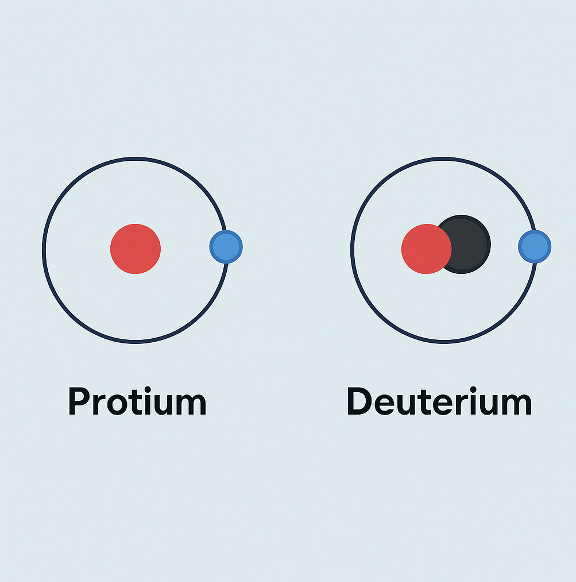 At the core of health is our ability to produce ATP efficiently and properly utilize it for all biological functions that maintain proper balance and wellness. Recall that the entire purpose of the ETC is to gather protons on one side of the membrane so that the ATP synthase can pump them through to the other side, thereby forming ATP. Protons, however, come in different sizes, 2 of which are applicable to biological discussion as the third is radioactive. Hydrogen is the first element on the periodic table and therefore contains one single proton and one electron. If the atom loses its electron and becomes H+, then it is simply a proton. This may be more specifically described as protium, or 1H+, as hydrogen can also come in the form of deuterium, 2H+, which contains both a proton and a neutron. Deuterium, containing two pieces is naturally heavier than protium.
Protium, being lighter, moves faster through the ATP pump and therefore is more efficient. The quality of protons passing through the ATP synthase pump, which are sourced from the liquid filling and surrounding all our cells, therefore becomes an important qualification to how effectively we produce ATP. However, this is not necessarily to say that the water we drink is the final determinate of this matter. Sure, it would be better to drink water low in deuterium, such as glacial water, especially if you live in an environment where there is not as much sunlight. Reason being, a low sunlight environment means your engines are running less efficiently (despite the cold adaptation), so it is simply better to give it cleaner fuel. Another source of protons that form the water surrounding our cells, which will end up providing the protons that pass through the ATP pump, is from our food. In a study that showed the deuterium depleted food produce antitumor effects in mice highlights how our food sources greatly affect the quality of the water produced during the ETC (Somlyai et al. 2022). A carbohydrate-rich diet will lead to metabolic water higher in deuterium, while lipids, given their complexity in structure, will tend to produce water with the lighter isotope of protium (Somlyai et al. 2022; Répás et al. 2025). This highlights the important of local environment when thinking about health: people who live in areas with less sunlight should focus on lowering their water’s deuterium content both in drinking water and in the foods they choose to eat (chiefly a fat-based diet).
The role of water in our bodies, as it relates to energy, potentially goes beyond the mere production of ATP. To understand this further involvement, a review of exclusion zone (EZ) water is necessary. EZ water is a special, structured form of water that forms next to hydrophilic (water-attracting) surfaces. Unlike ordinary bulk water, whose molecules are randomly jiggling, EZ water has an ordered, lattice-like arrangement of molecules. It’s generally negatively charged and pushes protons (positive charges) out into the surrounding water. This structure allows EZ water to behave differently from normal water. EZ water forms naturally with energy from light, especially infrared light, which is abundant in sunlight. Additionally, it may store information in a manner similar to computer memory (Pollack 2022).
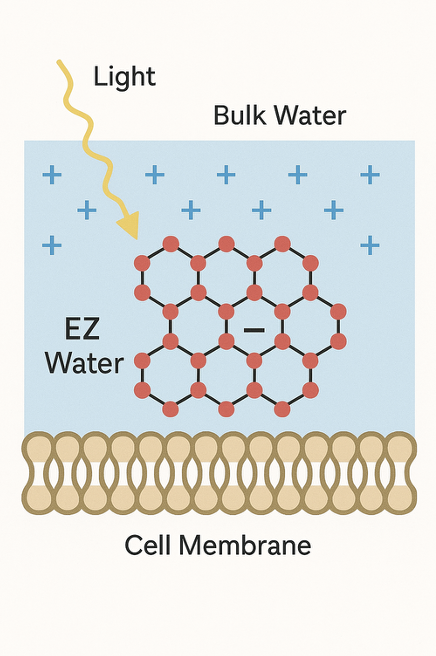 The role EZ water may have played in the origins of life is fascinating and worth a quick detour. EZ water, or “exclusion zone” water, forms when NIR light hits a hydrophilic surface (such as all cell membranes), causing nearby water molecules to organize into stable, honeycomb-like layers. Unlike ordinary bulk water, where molecules are in constant random motion, EZ water holds a precise, ordered arrangement of hydrogen and oxygen atoms. Each oxygen atom can exist in multiple oxidation states, creating a detailed pattern of charges within the structure. When a protein, or any charged molecule, is immersed in water, the distribution of charges on its surface imprints onto the adjacent EZ water layers. This imprint slightly alters the standard honeycomb pattern, producing a unique variant a kind of electrostatic proteinfingerprint. If the protein is later removed, the EZ retains this pattern as a kind of molecular memory. When new molecular building blocks enter the zone, the charge map of the EZ acts like a template or mold, guiding those molecules into positions that match the original pattern. Over time, those positioned molecules can bond into a new protein identical to the first. In this way, EZ water can store and replay structural information without DNA, making it a plausible medium for primitive molecular replication in the earliest stages of life’s development (Pollack 2022). Water may have carried the memory for the early building blocks of life.
As EZ water may have been critical in the formation of life on earth, so too is its potential role in the maintenance of life today. As the newly discovered EZ water has gained traction due to its scientific replicability, new hypotheses are beginning to arise regarding its role in human health. One such hypothesis involves the mechanisms of how ATP works.
Traditionally, ATP is taught as the unit of energy of the body. Once produced by the mitochondria, it travels around the body providing the energy required to trigger reactions needed for an assortment of vital bodily functions. However, with EZ water in mind, ATP may act more like a key that unlocks the available energy already contained around the various molecules. The hypothesis is as follows: EZ water forms hexagonal lattice while expelling protons into the surrounding bulk water. This separation of charges creates an electrochemical battery where stored energy can be harnessed when the lattice collapses. When ATP binds to a protein, the effect is not only to contribute its own chemical bond energy, but also to subtly alter the protein’s surface electrostatics and hydrogen bonding patterns, disrupting the surrounding EZ water structure. This disruption triggers a rapid collapse of the local EZ lattice, releasing stored electrostatic energy right at the site of action.
In muscle contraction, for example, this principle operates during the actin–myosin interaction. In the resting state, myosin heads are cocked but detached from actin, with EZ water potentially structured along the myofilament proteins, storing charge and maintaining an energy-rich environment. When ATP binds to myosin, it changes the protein’s conformation and charge distribution, destabilizing the EZ layer in its immediate vicinity. The collapse of this structured water releases stored potential and allows myosin to detach from actin more easily. As ATP is hydrolyzed to ADP and inorganic phosphate, the energy from both hydrolysis and EZ collapse primes the myosin head into a high-energy position. When phosphate is released, myosin rebinds actin and executes the power stroke, with the mechanical work powered not only by the chemical bonds of ATP but also by the sudden, localized release of EZ water energy. In this way, ATP acts as the signal that opens the battery of light-charged water, enabling precise, efficient, and targeted energy release for countless cellular processes.
If true, there are many profound implications toward human health. Recall that it is NIR light that interacts with water to form the EZ structure and the high viscosities outside of the hydrophilic membranes (Sommer, Haddad, and Fecht 2015; Sommer 2019). Meaning that NIR light is required to create the water environment necessary to allow for the use of ATP everywhere in the body. It is not enough to have healthy mitochondria that produce ATP, as it is simultaneously necessary for light to form the conditions in which the ATP can be utilized. Furthermore, it is important to consider the environmental pollutants that may hinder the development of EZ water. For example, fluoride (F⁻), the most electronegative anion, has been shown to disrupt the formation of exclusion zone (EZ) water (Sarka Pokorna, Piotr Jurkiewicz, Mario Vazdar, Lukasz Cwiklik, Pavel Jungwirth, Martin Hof 2014). Keep in mind that oxygen and nitrogen—the second and third most electronegative elements—while essential for life, can form reactive oxygen species (ROS) and reactive nitrogen species (RNS). These highly reactive derivatives cause stress on the body by stripping electrons from critical biomolecules, damaging proteins, lipids, and DNA. Chronic fluoride exposure from dietary and environmental sources may therefore not only impair EZ water formation but also contribute to the deterioration of multiple physiological functions due to its high electronegativity. Other pollutants influence this water formation may be WIFI, as research also suggest that WIFI impacts the formation of EZ water (Lee and Pollack 2021).
Magnetism
The final pillar yet to be discussed so far has been magnetism. While water and light form a symbiotic relationship in the production of ATP and the energy required for life, magnetism plays a slightly different role. As previously mentioned, electromagnetic waves, such as WIFI, may be very metabolically damaging due to its potential ability to destroy the EZ water structures necessary for the vital use of ATP.
That being said, the role of electromagnetic waves may be far more reaching, influencing the health of mitochondria and the electron transport chain itself. For example, a review of research surrounding a decline in fertility suggests that electromagnetic waves lead to an increased production of ROS from the electron transport chain and lead to further mitochondrial dysfunction (Santini et al. 2018). Additionally, recall that Complex IV is a receptor of NIR light, and this light increase the production of water through the consumption of oxygen (Huang et al. 2011). Nitric oxide (NO), can compete with oxygen, and inhibit the use of oxygen by Complex IV, and radiofrequency (RF) signals (which may come from cell phones, microwaves, and WIFI/Bluetooth devices) have been shown to increase the production of NO (Pilla 2012; Brown 2001). Essentially, the electromagnetic pollution we surround ourselves with is potentially dehydrating our bodies by reducing our ability to turn oxygen into the water. Furthermore, research also suggests that RF increase the production of ROS, further exaggerating the issue and causing further physiologic dysfunction (Yakymenko et al. 2016).
Consider that the atomic spins of the nuclei in certain atoms of the body may have always been effected by the magnetic fields of the Earth (Gurhan and Barnes 2023). One such field may include the Schumann resonance (~7.83Hz). With all the additional non-native EMFs in our modern environment, many potential consequences have potentially arisen that negatively influence metabolic health, as this is not the condition our bodies are evolutionarily suited for.
Further exaggerating the problem may be how non-native EMFs interact with chemicals found within our pharmaceutical products. SV40 (Simian Virus 40) is a virus that was discovered in the 1950s and was found to be contaminating polio vaccines, including the inactivated poliovirus vaccine (IPV). The contaminated vaccines were administered to millions of people, primarily in the United States, between 1955 and 1963, and have been linked to an increased risk of certain cancers, such as brain tumors and osteosarcomas. The contamination occurred because the vaccines were grown in monkey kidney cells that were infected with SV40, and the virus was not fully inactivated during the vaccine production process. Research has found that electromagnetic frequencies of 50Hz (those similar to the waves produced by power lines) increase the proliferation of SV40 in cell culture (Schimmelpfeng and Dertinger 1997). Furthermore frequencies of 60Hz has been shown to increase levels of hsp70 which has been shown to interact with cancer causing proteins (oncoproteins) such as SV40 (Goodman et al. 1994).
Conclusion
Modern medicine often focuses on treating disease with drugs designed to restore balance once something has gone wrong. But perhaps a better approach is to think about how we can maintain balance in the first place—by supporting the health and function of the body’s own energy generators. Instead of relying on supplemental remedies after illness develops, we should also look closely at the environment that contributed to sickness in the first place.
There are little resources more vital to the health of our mitochondria, and therefore bodies, than sunlight. Sunlight provides countless benefits to our body, such as IR-NIR light that makes our mitochondria engines more efficient. If we are without sunlight, then we require cold temperatures and high-fat diets to sustain health. This is because the water we produce inside the body is of vital importance. Clean drinking water is a modern luxury. Ancient humans produced their water internally, which was lighter, due to their superior mitochondrial function and health. Not only do we modern humans live indoors, depriving our bodies of natural sunlight, we also live in temperature regulated homes that do not allow us to become cold as a substitute. This is all made worse by the fact that we surround ourselves with non-native EMFs, further driving mitochondrial dysfunction and metabolic disease.
We as a people most remember that we are beings of nature. We are all beings of light and required the gifts of the outside world to survive. From this perspective, modern medicine tends to ignore the obvious truth: we are sick because of our indoor and technology polluted lives. The path towards health is a return to a more natural state of being, surrounded by a more natural environment.
References
Brown, G. C. 2001. “Regulation of Mitochondrial Respiration by Nitric Oxide Inhibition of Cytochrome c Oxidase.” Biochimica et Biophysica Acta 1504 (1): 46–57.
De Freitas, Lucas Freitas, and Michael R. Hamblin. 2016. “Proposed Mechanisms of Photobiomodulation or Low-Level Light Therapy.” IEEE Journal of Selected Topics in Quantum Electronics: A Publication of the IEEE Lasers and Electro-Optics Society 22 (3): 348–64.
Goodman, R., M. Blank, H. Lin, R. Dai, O. Khorkova, L. Soo, D. Weisbrot, and A. Henderson. 1994. “Increased Levels of Hsp70 Transcripts Induced When Cells Are Exposed to Low Frequency Electromagnetic Fields.” Bioelectrochemistry and Bioenergetics (Lausanne, Switzerland) 33 (2): 115–20.
Gurhan, Hakki, and Frank Barnes. 2023. “Impact of Weak Radiofrequency and Static Magnetic Fields on Key Signaling Molecules, Intracellular PH, Membrane Potential, and Cell Growth in HT-1080 Fibrosarcoma Cells.” Scientific Reports 13 (1): 14223.
Huang, Ying-Ying, Sulbha K. Sharma, James Carroll, and Michael R. Hamblin. 2011. “Biphasic Dose Response in Low Level Light Therapy - an Update.” Dose-Response: A Publication of International Hormesis Society 9 (4): 602–18.
Lee, Ji Won, and Gerald Pollack. 2021. “Impact of WI-Fi Energy on EZ Water.” ScienceOpen. https://doi.org/10.14293/s2199-1006.1.sor-.ppiq9g6.v1.
Lim, Sharon, Jennifer Honek, Yuan Xue, Takahiro Seki, Ziquan Cao, Patrik Andersson, Xiaojuan Yang, Kayoko Hosaka, and Yihai Cao. 2012. “Cold-Induced Activation of Brown Adipose Tissue and Adipose Angiogenesis in Mice.” Nature Protocols 7 (3): 606–15.
Oswal, A., and G. S. H. Yeo. 2007. “The Leptin Melanocortin Pathway and the Control of Body Weight: Lessons from Human and Murine Genetics.” Obesity Reviews. https://doi.org/10.1111/j.1467-789X.2007.00378.x.
Pilla, Arthur A. 2012. “Electromagnetic Fields Instantaneously Modulate Nitric Oxide Signaling in Challenged Biological Systems.” Biochemical and Biophysical Research Communications 426 (3): 330–33.
Pollack, Gerald H. 2022. “EZ Water and the Origin of Life.” Annual Research & Review in Biology, August, 18–28.
Poyton, Robert O., and Kerri A. Ball. 2011. “Therapeutic Photobiomodulation: Nitric Oxide and a Novel Function of Mitochondrial Cytochrome C Oxidase.” Discovery Medicine 11 (57): 154–59.
Répás, Zoltán, Zoltán Győri, Orsolya Buzás-Bereczki, and László G. Boros. 2025. “The Biological Effects of Deuterium Present in Food.” Discover Food 5 (1): 1–10.
Rousset, Sophie, Marie Clotilde Alves-Guerra, Julien Mozo, Bruno Miroux, Anne Marie Cassard-Doulcier, Frédéric Bouillaud, and Daniel Ricquier. 2004. “The Biology of Mitochondrial Uncoupling Proteins.” Diabetes 53 (suppl_1): S130–35.
Santini, Silvano Junior, Valeria Cordone, Stefano Falone, Mahmut Mijit, Carla Tatone, Fernanda Amicarelli, and Giovanna Di Emidio. 2018. “Role of Mitochondria in the Oxidative Stress Induced by Electromagnetic Fields: Focus on Reproductive Systems.” Oxidative Medicine and Cellular Longevity 2018 (1): 5076271.
Sarka Pokorna, Piotr Jurkiewicz, Mario Vazdar, Lukasz Cwiklik, Pavel Jungwirth, Martin Hof. 2014. “Does Fluoride Disrupt Hydrogen Bond Network in Cationic Lipid Bilayer? Time-Dependent Fluorescence Shift of Laurdan and Molecular Dynamics Simulations.” The Journal of Chemical Physics 22. http://ouci.dntb.gov.ua/en/works/4bMJANe7/.
Sazzini, M., G. Schiavo, S. De Fanti, P. L. Martelli, R. Casadio, and D. Luiselli. 2014. “Searching for Signatures of Cold Adaptations in Modern and Archaic Humans: Hints from the Brown Adipose Tissue Genes.” Heredity 113 (3): 259–67.
Schimmelpfeng, J., and H. Dertinger. 1997. “Action of a 50 Hz Magnetic Field on Proliferation of Cells in Culture.” Bioelectromagnetics 18 (2): 177–83.
Somlyai, Gábor, Lajos I. Nagy, László G. Puskás, András Papp, Beáta Z. Kovács, István Fórizs, György Czuppon, and Ildikó Somlyai. 2022. “Deuterium Content of the Organic Compounds in Food Has an Impact on Tumor Growth in Mice.” Current Issues in Molecular Biology 45 (1): 66–77.
Sommer, Andrei P. 2019. “Mitochondrial Cytochrome c Oxidase Is Not the Primary Acceptor for near Infrared Light—It Is Mitochondrial Bound Water: The Principles of Low-Level Light Therapy.” Annals of Translational Medicine 7 (S1): S13–S13.
Sommer, Andrei P., Mike Kh Haddad, and Hans Jörg Fecht. 2015. “Light Effect on Water Viscosity: Implication for ATP Biosynthesis.” Scientific Reports 5 (July). https://doi.org/10.1038/srep12029.
Yakymenko, Igor, Olexandr Tsybulin, Evgeniy Sidorik, Diane Henshel, Olga Kyrylenko, and Sergiy Kyrylenko. 2016. “Oxidative Mechanisms of Biological Activity of Low-Intensity Radiofrequency Radiation.” Electromagnetic Biology and Medicine 35 (2): 186–202.