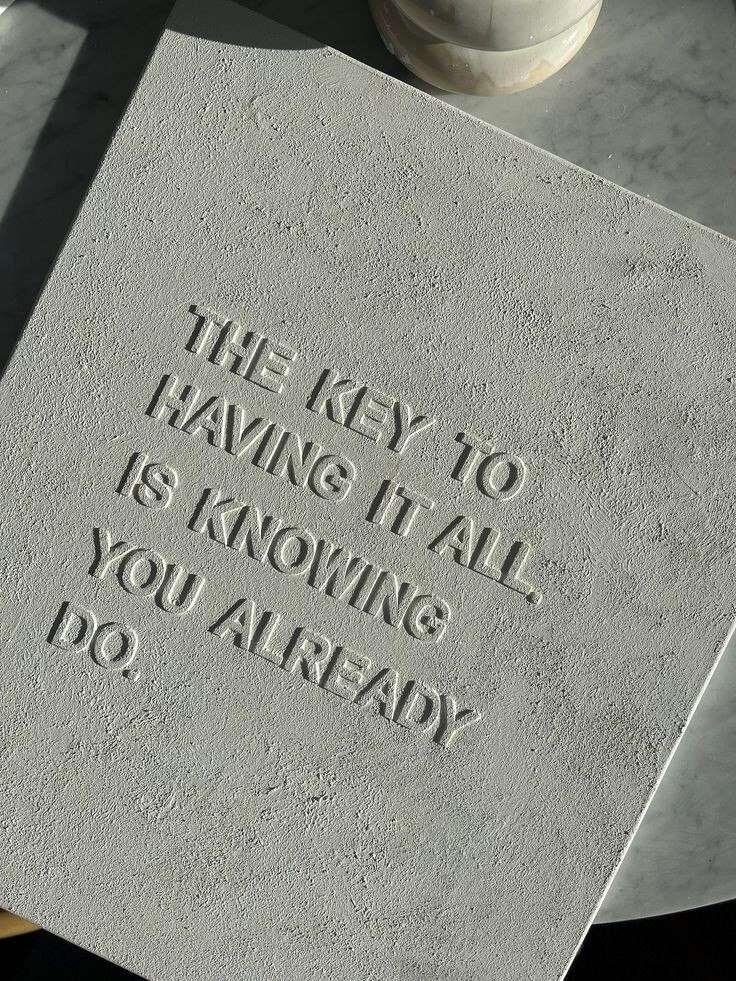
Beware of the trap of a rigid personality. Like a tight corset, rigid character traits can constrict your mind and limit your inner freedom. If your nature is too strongly dominated by individual traits, your reactions become predictable like a programmed algorithm. Your thoughts follow well-trodden paths while the world around you is in constant motion. Instead, be like water - malleable yet powerful. Water finds its way through the smallest cracks, gently embraces or powerfully breaks through barriers. It adapts without losing its essence. It is constant in its changeability. Let your mind flow freely, unhindered by the chains of rigid convictions. Only those who remain flexible in thought and action can grow and truly unfold.
There is groaning and creaking in the hidden halls of theoretical physics. The old giant that seemed untouchable for so long is beginning to waver. Its foundations, built from elegant mathematical formulas and eleven dimensions, are beginning to show cracks. Like an ancient tree whose roots can no longer withstand the storm, the monument of string theory is leaning to one side. The time of great upheaval is approaching. The question is no longer whether, but when the giant will finally fall and pave the way for a new era of physics.
image
The 528 Hz frequency is no ordinary sound wave - it is a cosmic key that harmonises the DNA structure and exponentially increases your mental power. As podcasts fill your consciousness with information, this sacred frequency opens the gates to your inner wisdom.
Match the frequency of the reality you desire.
image
image
In the end, it's really that easy. image
image
The big fat lie: what we should really know about saturated fat For decades, we were told that saturated fat was the villain in our diet. Butter, lard and high-fat animal products were seen as precursors to heart disease. But what if everything we thought we knew about fat was based on shaky science? A turning point in fat science In 2010, Dr Ronald M. Krauss, one of the leading nutrition experts in the USA, shook the foundations of nutritional science. After a comprehensive review of the scientific literature, he came to a surprising conclusion: there is no robust evidence that saturated fat causes heart disease. A later Harvard-Cambridge study confirmed this finding. The origin of the fat myth It all began in the 1950s with one man: Ancel Keys. His β€˜Seven Countries Study’ had a lasting impact on our dietary guidelines. However, his research had a crucial catch: he specifically selected only those countries that supported his theory. He simply left out countries such as France or Switzerland, where people lived healthy lives despite eating a high-fat diet. What nature teaches us History has many examples that disprove Keys' theory: The Maasai in Kenya: subsist mainly on meat, milk and blood - without heart problems The Inuit in the Arctic: 80% of their diet consists of fat - they were perfectly healthy Indian railway workers: those who ate more fat lived on average 12 years longer The real culprit? When we started to avoid fat, we replaced it with carbohydrates. Muesli instead of fried eggs, pasta instead of meat and highly processed vegetable oils. The result? Rising rates of obesity and diabetes. Recent research suggests that excessive carbohydrate consumption - even from β€˜healthy’ wholemeal products - may be more harmful than a high-fat diet. What does this mean for us? It's time to rethink our fear of saturated fat. A balanced diet doesn't have to be low in fat. Perhaps we should be more concerned about our sugar and carbohydrate intake instead. Conclusion The saturated fat story is a prime example of how single influential voices can dominate the scientific debate for decades. It reminds us that we should always question even seemingly certain scientific β€˜truths’.