@The Guardian World

Analysis from Institute for Fiscal Studies says in short term figure will be lowerGood morning. Normally child poverty is not at the centre of the national political debate (although it probably should be). But yesterday, at PMQs, Kemi Badenoch did make it a lead talking point by asking Keir Starmer if he would commit to keeping the two-child benefit cap, the Osborne-era benefit cut that is seen as a key driver of child poverty. She was doing this not because she wanted to promote the Tories as supporters of child poverty (although arguably that is one interpretation of her stance), but because she knows the policy is popular with voters who accept George Osborne’s argument that it is unfair for the state to pay very poor people to have more than two children when many other parents restrict the number of children they have depending on what they can afford. (Welfare experts say this is a grossly misleading caricature of why people with three or more children end up needing benefits, and that even if it was true it would be unfair to punish children, but in the court of public opinion, the Osborne argument still seems to be winning.) Badenoch was using as a classic ‘wedge issue’, and her question was designed to force Starmer to choose between siding with Labour MPs (who want the cap to go) and mainstream voters (who want to to stay, by almost two to one, according to some polling).Badenoch did not get very far because Starmer just dodged the question. (That does not mean she was wrong to identify this as a dilemma for Labour; it just means Starmer avoided it becoming a problem yesterday.) It is still not clear what Starmer will do about the two-child benefit cap. But he told MPs at lunchtime yesterday: “I believe profoundly in driving down poverty and child poverty.”Over half a million more children will benefit from a free nutritious meal every school day, as the government puts £500 back into parents’ pockets every year by expanding eligibility for free school meals.From the start of the 2026 school year, every pupil whose household is on Universal Credit will have a new entitlement to free school meals. This will make life easier and more affordable for parents who struggle the most, delivering on the government’s Plan for Change to break down barriers to opportunity and give children the best start in life.Offering free school meals to all children whose families receive universal credit will, in the long term, mean free lunches for about 1.7 million additional children. But transitional protections introduced in 2018 have substantially increased the number of children receiving free school meals today - so in the short run, today’s announcement will both cost considerably less (around £250m a year) and benefit considerably fewer pupils (the government’s estimate is 500,000 children). This also means that today’s announcement will not see anything like 100,000 children lifted out of poverty next year. Continue reading...

the Guardian
Truss should be banned from ever running as Tory candidate again to show ‘we get it’, says former minister – as it happened
Conservative party urged to ‘draw a line’ under the Liz Truss era and never again endorse her as candidate

 UK ministers working to secure carve-out from 50% rate for Indian-owned Port Talbot worksUK politics live – latest updatesMinisters are reportedly working to stop the UK’s biggest steelmaker, Tata Steel, from being left out of tariff-free access to the US under Keir Starmer’s trade deal with Donald Trump.The prime minister said on Wednesday that he hoped his deal with the US – which has been agreed but not signed – would come into effect “in just a couple of weeks”, after the US president decided to pause 50% tariffs on British steel and aluminium products for five weeks. Continue reading...

 Remains of Judih Weinstein and Gad Haggai returned to Israel after overnight operation in southern GazaIsrael has recovered the bodies of two Israeli-American hostages who were killed and abducted in Hamas’s 7 October 2023 attack. The Israeli prime minister, Benjamin Netanyahu, said the remains of Judih Weinstein, 70, and Gad Haggai, 72, both of whom had Israeli and US citizenship, were returned to Israel by the army and the Shin Bet internal security agency after an overnight operation in southern Gaza.Their deaths had been announced in December 2023. “My beautiful parents have been freed. We have certainty,” their daughter, Iris Haggai Liniado, wrote in a Facebook post. She thanked the Israeli military, the FBI and the Israeli and US governments and called for the release of all the remaining hostages. Continue reading...

 Legal scholar condemns ‘stigmatising’ law that bars such content from schools and primetime TVEurope live – latest updatesThe Guardian view on Hungary’s anti-LGBTQ+ lawsA Hungarian law banning content about LGBTQ+ people from schools and primetime TV has been found to violate basic human rights and freedom of expression by a senior legal scholar at the European court of justice.The non-binding opinion from the court’s advocate-general, Tamara Ćapeta, issued on Thursday, represents a comprehensive demolition of the arguments made by the Hungarian government defending its so-called childprotection law, passed in 2021. Continue reading...

 Money transfer service Wise will switch primary listing to US and dual list shares to try to lure more investorsThe online payments company Wise has said it will move its main share listing to the US, in the latest blow to London’s beleaguered stock market.Wise, which is one of the biggest financial technology businesses in the country and has been listed in London since 2021, said on Thursday that it now intends to dual list its shares in the US and the UK in an attempt to attract more investors and boost its value. Continue reading...

 Eighty-year-old singer has another health setback, following cancelled concerts earlier this yearRod Stewart has cancelled two concerts this week while he recovers from a bout of flu.As he considers one of the biggest gigs of his life later this month, playing to what is likely to be more than 100,000 people at Glastonbury’s Pyramid stage, Stewart cancelled performances at the Colosseum theatre in Caesar’s Palace, Las Vegas. Continue reading...

 Cooke, who ran the Royal Court for several years, will succeed Rupert Goold at the illustrious London venue in 2026Dominic Cooke has been appointed as the new artistic director of the Almeida theatre in London, succeeding Rupert Goold in 2026.Cooke ran the Royal Court for several years and is an in-demand director with recent hits in the West End and at the National Theatre. “Twelve years after leaving the Royal Court, I couldn’t be more excited to be returning as an artistic director and to be taking the reins of this unique theatre,” he said. He described Goold’s Almeida as “a beacon of quality and innovation” and added: “I’m hugely grateful to him and his team to be handed an organisation in such good health. I look forward to building on this legacy and to future adventures in this magical space.” Continue reading...

 Parliament votes to enact punishment after hours of fraught debate including attitudes towards Māori cultureNew Zealand legislators have voted to enact record parliamentary suspensions for three MPs who performed a Māori haka to protest against a controversial proposed law.Hana-Rāwhiti Maipi-Clarke received a seven-day ban and the leaders of her political party, Te Pāti Māori (the Māori party), Debbie Ngarewa-Packer and Rawiri Waititi, were barred for 21 days. Three days had previously been the longest ban for a New Zealand MP. Continue reading...

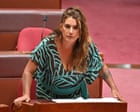 Independent senator – who made complaint about Cox – says Labor needs to take bullying allegations in the workplace seriouslyAustralia news live: latest politics updatesGet our breaking news email, free app or daily news podcastLidia Thorpe has urged Anthony Albanese to “do his homework” on bullying allegations against Greens turned Labor senator Dorinda Cox, claiming the prime minister was “wrong” to publicly declare the matters had been dealt with.The independent Victorian senator – previously a member of the Greens – revealed on Wednesday she had formally filed a bullying complaint against Cox in March 2023, months after she first notified the then Greens leader, Adam Bandt.Sign up for Guardian Australia’s breaking news email Continue reading...

 Higgins decries pushback against ‘the very idea that sexual violence deserves to be taken seriously’ in first speech since returning to public lifeAustralia news live: latest politics updatesGet our breaking news email, free app or daily news podcastBrittany Higgins has warned of an orchestrated “backlash” to the #MeToo movement in her first speech since returning to public life.During her keynote address to the fourth Conversations That Matter event in Geelong on Thursday, Higgins also urged the Albanese government to use its election mandate to “transform how sexual assault is handled in Australia”.Sign up for Guardian Australia’s breaking news email Continue reading...
