"It might make sense to get some in case it catches on." - #SatoshiNakamoto First Edition auction ending in just a few hours. See link below. #Bitcoin #BitcoinArt image
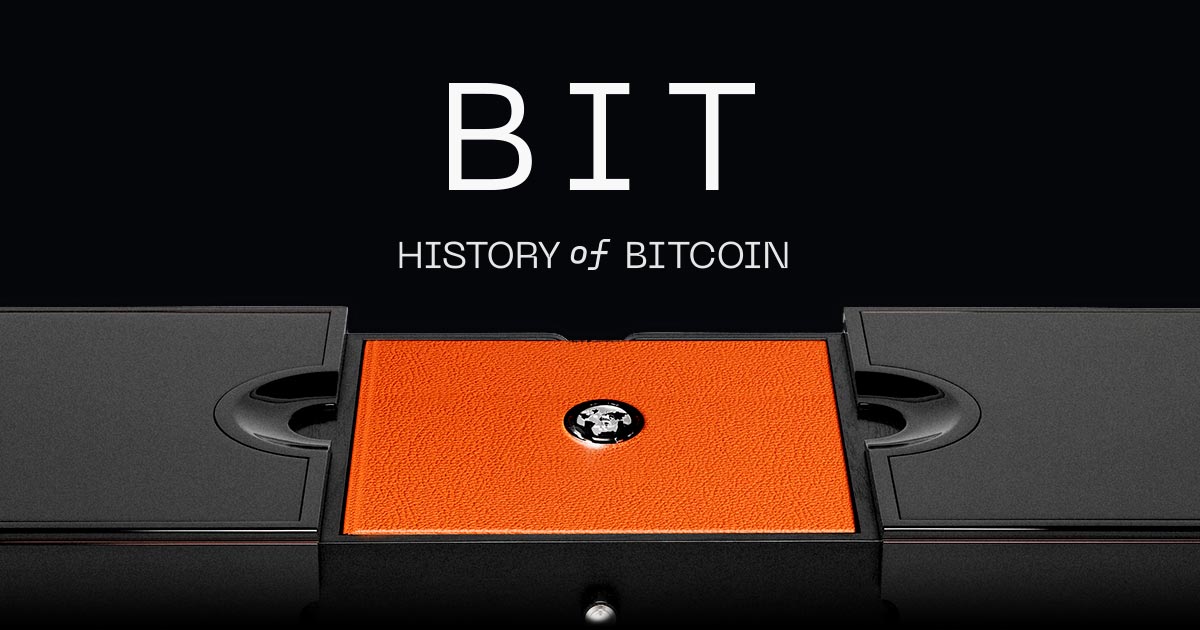
Here is a rare glimpse inside the one-of-a-kind presentation box of the First Edition. Its dual-opening system was hand-crafted by master craftsmen over months and engineered with the same precision and intentionality that defines Bitcoin itself. Auction ends in 5 hours. Bid here: #Bitcoin #BitcoinArt image
Had a great time showing @The Bitcoin Conference in Dubai attendees the first edition! Auction ends in just a few hours! image
Today is the final day of the auction for the First Edition of the History of #Bitcoin. Encased in 5,000 year old fossilised oak and crowned with a one of one silver emblem crafted by Asprey Studio, it is the only edition of its kind and the highest expression of Bitcoin’s cultural record. The current bid stands at 14 million sats. Proceeds from this First Edition directly support My First Bitcoin’s free education programs, helping preserve Bitcoin’s history while empowering the next generation to build its future. The First Edition is presented in a handcrafted case made from ancient fossilised black oak, England’s rarest native hardwood. Shaped over six months by a master craftsman with more than thirty five years of experience, the case reflects permanence, precision, and traditional artistry. An innovative dual sided opening mechanism completes the design, creating an unboxing experience as considered as the work it protects. The bound volume is crowned with a one of one silver Bitcoin emblem created by #AspreyStudio in Mayfair, London. Asprey is known for its mastery of silversmithing, precision metalwork and heritage craftsmanship. Their work is sought after by collectors worldwide for its blend of tradition and innovation. Inside the book are 128 archival quality artworks created by world leading artists, printed on fine art papers selected to last for generations. Each page is enhanced with specialty processes including metallic foils, UV varnish, mirror papers, embossing and custom inks. Seamless layflat binding allows each artwork to span the full spread without interruption. The book itself is cased in premium bull leather, dyed in Bitcoin’s signature orange. It was chosen for its durability and natural character, embodying both the strength and symbolism of the Bitcoin bull. A defining feature of the edition is the inclusion of the complete Bitcoin source code, with each book in the series containing a unique fragment. Together, collectors form a network that mirrors Bitcoin’s distributed structure. The First Edition contains the very first fragment. The book is accompanied by Revelations, a pocket sized companion that connects every artwork to its historical moment, drawing on first hand accounts from more than one hundred early Bitcoiners. The art captures each moment. Revelations anchors it in documented history. More than three hundred people contributed to this project over four and a half years. Whoever wins this auction becomes the custodian of a singular cultural artefact while directly funding Bitcoin education for future generations. The auction ends today. Bid here: #BitcoinArt #Art
It was an honour to show the History of #Bitcoin to @Michael Saylor and his highness Ahmed bin Hamdan al Nahyan at @The Bitcoin Conference! image
Did you know the #Bitcoin logo we use today wasn’t the original? Its evolution reflects the community’s earliest debates about identity, symbolism and usability. In February 2010, #Bitcointalk user #NewLibertyStandard proposed two things: • adopting the Thai baht symbol (฿) for Bitcoin • using BTC as the three-letter currency code BTC caught on immediately. The symbol sparked debate. Some disliked borrowing from an existing currency; others argued that using a symbol already present in global keyboards and systems would accelerate adoption. #HalFinney joined the discussion, noting the dollar sign originally had two vertical bars, a subtle nod that helped push the Bitcoin community toward a similar aesthetic. Later that month, #Satoshi released a new logo: still a gold coin, but now featuring a B with two partial vertical strokes, distinguishing it from the baht (whose bar passes fully through). It was an improvement, though not universally loved. That changed on November 1st, 2010, when forum user bitboy introduced a new design: • flat, modern, and bright orange • the tilted ₿ we all recognise today The community embraced it instantly. Within months, the gold coin motif disappeared entirely. Bitcoin finally had a symbol that felt contemporary, global and native to the internet. A final milestone came years later when researcher Ken Shirriff succeeded in adding the Bitcoin symbol to Unicode. Before this, people resorted to pasting images or using the baht symbol as a workaround. His Unicode proposal was accepted, making ₿ an officially recognised character. He later donated the bitcoin he received in thanks to fund clean-water projects in Africa. From BC → ฿ → ₿, Bitcoin’s visual identity emerged the same way its technology did: openly, collaboratively and through community consensus. Read the full story: Artwork: A Symbolic Day by Marinel Sheu, featured in the History of Bitcoin Collector’s Book and interactive timeline. #BitcoinArt #Art #DigitalArt
#Bitcoin doesn’t just run on energy. It runs on a self-correcting feedback loop #Satoshi embedded into the code from day one: the difficulty adjustment. Art by Arturo Fernández • Guest writer: Jason Deane Just one month after Bitcoin launched, the network hit a milestone that still defines its rhythm today – the first mining difficulty adjustment. Miners validate transactions, secure the network and issue new BTC according to rules fixed in the protocol. Blocks are meant to arrive every 10 minutes, but in an open system anyone can join or leave at any time. If too much hash power enters the network, blocks arrive faster. If miners leave, block times slow and transactions jam. Satoshi needed a mechanism to keep the heartbeat steady. His solution: every 2,016 blocks, the network automatically recalibrates difficulty based on how long the previous 2,016 blocks took to mine. If blocks were mined too quickly, difficulty rises. If they were slow, difficulty drops. This keeps Bitcoin anchored to its 10-minute rhythm, regardless of how much hash power comes online. The math is simple: Expected time (20,160 minutes) / actual time = adjustment factor. That factor is applied to the new difficulty. On February 18th, 2009, the very first adjustment increased difficulty from 1.0T to 1.18T – an 18 percent jump that prevented blocks from being solved too quickly. A second adjustment followed on February 29th. The mechanism has fired reliably every two weeks since, despite an astronomical rise in global hash power. Sixteen years on, Bitcoin still functions exactly as Satoshi designed: decentralized, predictable and self-stabilizing. Read the full article: This artwork, “THE GAME GETS HARDER,” appears in the History of Bitcoin Collector’s Book and on the interactive timeline.
In #Bitcoin’s earliest days, mining didn’t require warehouses of #ASICs. You could earn 50 BTC by clicking “Generate Coins” on your home computer. Few recognised value in something that appeared worthless, but those early clicks helped secure a revolution. Art by Caspian Ievers, with insights from Sergio Demian Lerner Bitcoin mining today evokes vast data centres, but in 2009 it was far simpler. The first #BitcoinWallet, built by #Satoshi, let anyone mine with a couple of clicks. His readme.txt explained that users could support the network by running a node and keeping “Generate Coins” enabled. Blocks could take days or months to find, but mining ran quietly in the background. Notably, Satoshi didn’t use the term “mining” at all. He called it “generating,” and early users could generate coins with no cost beyond their computer’s idle time. Most of these early “zero-value” coins are believed to have been mined by Satoshi. Researcher Sergio Demian Lerner identified a unique fingerprint showing that a single entity mined roughly 1.1M BTC in 2009–2010. He argues that Satoshi’s concentrated hashrate was likely essential to protect the network when it was most vulnerable. Satoshi gradually stepped back as new miners arrived, decentralising the network at the moment it became secure enough to stand on its own. And he encouraged others to participate, writing: “As a reward for supporting the network, you receive coins when you successfully generate a block.” Mining on a home computer remained viable until late 2009, when difficulty began to rise. Yet very few people used the feature. One early #Bitcointalk user later reflected: “Remember when mining BTC was as easy as ‘click generate’? Even then, very few did, and most didn’t do it for long.” Satoshi didn’t just create a peer-to-peer money system, he designed a fair way for anyone to help secure it, long before today’s industrial mining landscape. Read the full article: This artwork, “GENERATE COINS,” appears in the History of Bitcoin Collector’s Book and on the interactive timeline. #BitcoinArt #Art
Bid now on this one-of-a-kind piece to support an incredible charity @My First Bitcoin. shop.historyofbitcoin.io/first-edition "The auction is at 6M sats and rising, and you still have six days to join and own a unique art piece that becomes part of history while supporting Independent #Bitcoin Education Worldwide."
If the #blockchain records the transactions, #Bitcointalk records the humanity. It is the archive that captured #Bitcoin’s earliest culture: Satoshi’s posts, first debates, early memes and the birth of a movement. Artwork by Sasha Stiles (@sashastiles). While Bitcoin’s blockchain preserves its on-chain history, the Bitcointalk forum has become the permanent record of everything that happened around it. Across thousands of posts, you can trace the ideas, personalities and tensions that shaped Bitcoin long before it went mainstream. The forum originally lived at bitcoin dot org/smf and later at forums.bitcoin dot org before moving to bitcointalk dot org in 2011. Registered by Satoshi on November 17 2009, it quickly became the centre of discussion for the early community. From technical questions about how to run a node to philosophical debates about privacy and value, the forum documented Bitcoin’s evolution from concept to reality. #Satoshi posted only 575 times during the 13 months he was active, but every message now serves as a historical artefact. Alongside him were names who would later become central to Bitcoin’s story: #HalFinney, @Martti Malmi, Gavin Andresen and even a young #VitalikButerin. In its earliest months, the forum felt small and united. A few dozen users experimented with the software, shared ideas and worked together to help Bitcoin grow. They did not know where Bitcoin was headed, but they sensed they were building something meaningful. After Satoshi stepped back, Martti Malmi took over as lead admin, later passing the role to #Theymos in 2012, who continues to maintain the forum. Though not decentralised, Bitcointalk has remained resistant to censorship and has preserved its grassroots ethos as Bitcoin expanded into global territory. Many pivotal early events occurred on Bitcointalk, including the first bitcoin to fiat trade in 2009. They remain archived there today, forming a parallel ledger of the human side of Bitcoin’s origin story. Read the full article: Artwork: A Forum for Debate by Sasha Stiles (@sashastiles). Appears in the History of Bitcoin Collector’s Book and on our interactive timeline.