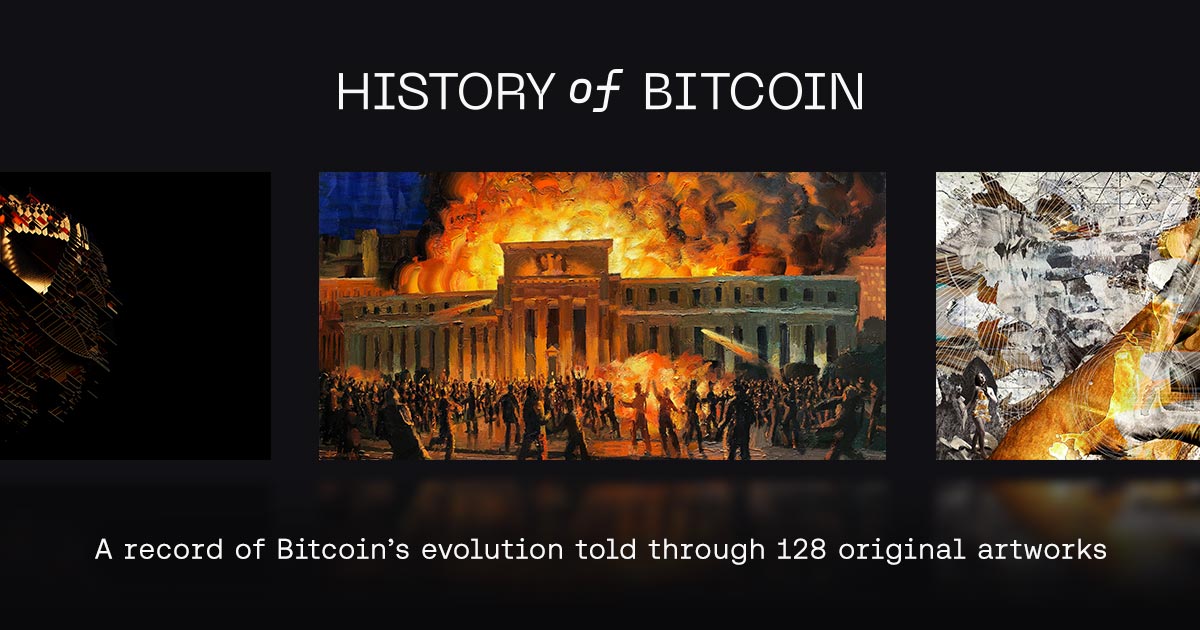
PAY ATTENTION TO BITCOIN WHEN THE WORLD IS FALLING APART. Every major global crisis has pushed more people toward #Bitcoin. 2009: Financial crisis → Genesis Block 2013: Cyprus bank haircuts → Bitcoin surges 2020: Pandemic fear → +416% 2025: You are here. The history matters. While Wall Street was burning in 2008, #SatoshiNakamoto was quietly building an exit. As the global financial system cracked under the weight of reckless lending, collapsing banks, and evaporating trust, #Satoshi was assembling a new kind of monetary architecture, one that didn’t depend on the stability or honesty of financial institutions. The crash began long before Lehman Brothers fell. In early 2007, New Century Financial collapsed under subprime defaults. HSBC announced a $10.5B write-down. Bear Stearns froze withdrawals in its mortgage-backed hedge funds. The warning signs were there, but few listened. By 2008, the dominos fell fast: Bear Stearns collapsed, Lehman Brothers died after 158 years, credit markets froze, and panic spread globally. Governments rushed in with bailouts while the public watched trust evaporate. During this period, #Satoshi was finalising the #BitcoinWhitepaper, opening with a simple idea and ending with a powerful message: electronic payments without relying on trust. Satoshi had started working on Bitcoin in mid-2007, around the exact time “bank run” re-entered common vocabulary. The timing wasn’t an accident. He recognised the need for a monetary system that couldn’t be manipulated, frozen, or debased by failure-prone institutions. On August 22, 2008, as markets were deteriorating further, he contacted Wei Dai to reference the earlier “b-money” concept. Bitcoin was nearing completion just as the traditional system was in freefall. Then came the statement that immortalised the moment: “The Times 03/Jan/2009 Chancellor on brink of second bailout for banks.” Embedded forever in Bitcoin’s Genesis Block, a timestamped reminder that Bitcoin was born from a crash. We capture this pivotal chapter in “The History of Bitcoin by Smashtoshi,” accompanied by artwork from Alex (@paintwithalex over on X). It appears in the History of Bitcoin Collector’s Book and on our interactive timeline. Read the full article:
To understand #Bitcoin’s resilience, it helps to understand the ideas that came before it. One of the most important was @npub1stxe...lzp0 Bit Gold, a direct intellectual ancestor to #Bitcoin and a critical step in the evolution of electronic cash. Szabo was one of the #Cypherpunks who worked at David Chaum’s #Digicash in Amsterdam. But while he was there, he realized that #Ecash had a fundamental flaw: it was centralised. Employees theoretically had the ability to secretly issue coins and manipulate the system. This insight led Szabo to a principle he repeated often: “Trusted third parties are security holes.” About a year after @Adam Back introduced #Hashcash, Szabo used its proof-of-work mechanism to design a new kind of digital money that didn’t rely on any single operator: Bit Gold. Like Hashcash, #BitGold units were created by hashing. Only some hashes were valid, and finding one required computational work. But Bit Gold added a new twist: when someone found a valid hash, they would publish it publicly and “own” it. The hash would be attributed to their public key. If they later wanted to transfer it, they would publish a signed message assigning ownership to a new public key. But Bit Gold faced two major challenges before it could function as money. The first was inflation. As computers become more powerful, generating valid hashes gets easier. Over time, the supply of new Bit Gold units could explode. Szabo envisioned a complex mechanism to stabilise difficulty and reduce technological inflation, but it was never fully fleshed out. The second challenge was ownership tracking. Szabo imagined a distributed registry to keep track of which public keys owned which hashes. But trusted third parties were not acceptable, so this registry would have to be maintained by a group of users. In theory, if a conflict occurred, such as a double spend, this group would resolve it through a sophisticated voting process. But Szabo never explained who these users would be, how they would be chosen, or how to prevent collusion and #Sybil attacks. In the end, Bit Gold was never implemented. It wasn’t yet equipped to solve these economic and coordination problems. Even so, Bit Gold represented a huge leap forward. It pushed the concept of digital money closer to what Bitcoin would eventually become, introducing ideas that would later prove essential. We honour this chapter in “The History of Bitcoin by Smashtoshi” with original artwork by Smashtoshi. It appears in the History of Bitcoin Collector’s Book and on our interactive timeline. You can read the full article by Aaron van Wirdum here:
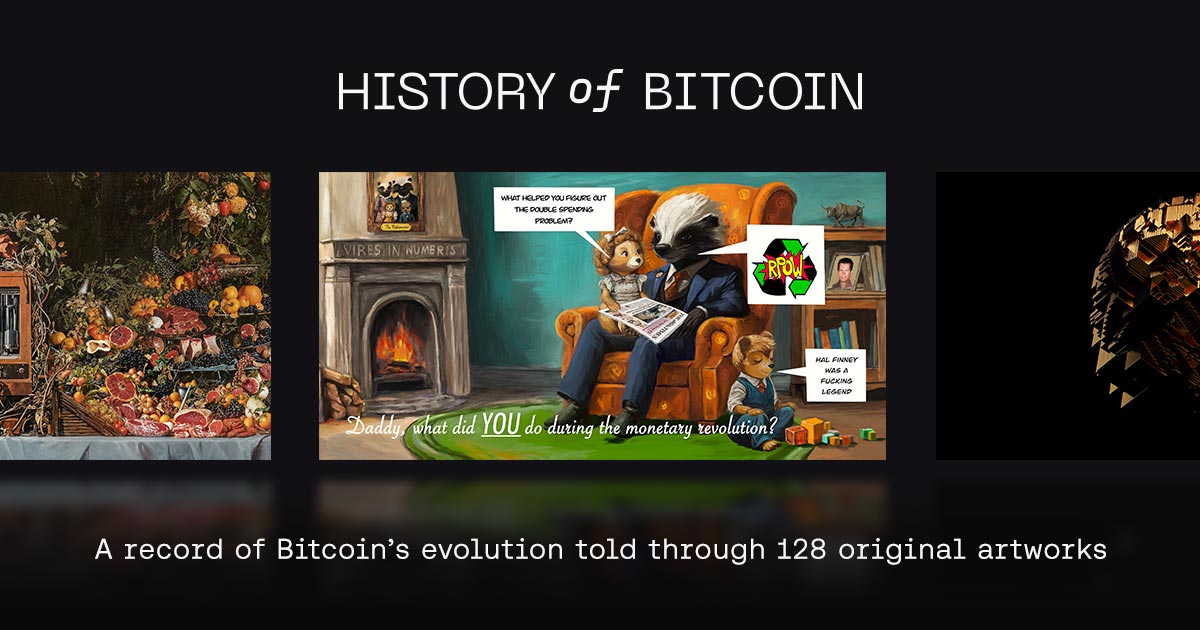
Red candles come and go. History says relax. Long before #Bitcoin existed, #HalFinney was keeping the #Cypherpunk dream alive. Even in the early 2000s, when many had lost hope that electronic cash would ever work, Finney refused to give up. Hal wasn’t just an early #Bitcoiner, he was one of the most committed Cypherpunks. A video game developer from California and an early contributor to PGP, he reviewed almost every e-cash proposal the mailing list produced. In 2004, he launched his own system: Reusable Proof of Work (#RPOW). Like #Hashcash and #BitGold, RPOW used proof of work to create new value. Users would connect to a server operated by Finney, solve a PoW challenge, and receive an RPOW token. The server kept a database of issued tokens to prevent double spending. To spend RPOW, you simply sent your token to someone else. They would then forward it to the RPOW server, which validated it and issued them a new one. In this way, proof of work became reusable. Privacy was built in. All connections to the server went through Tor, so Hal never knew who his users were. To guarantee honesty, Finney relied on open-source software and a new technique called “remote attestation.” The RPOW code ran on a special IBM chip that could cryptographically prove it was running the correct software, ensuring that no one, not even Hal, could secretly mint tokens. Unlike Bit Gold, RPOW was actually implemented and ran in the real world. But it had one major flaw: as computers became faster, generating new RPOW tokens became easier. Over time, the currency would inflate. There was no economic incentive to hold or accept it. Without that, RPOW never gained traction. Finney had solved electronic cash on a technical level, but the economics weren’t right. Bitcoin would later fix that by aligning incentives with proof of work. We honour this chapter in “The History of Bitcoin by Smashtoshi” with the artwork: “REUSABLE WORK” by Yonat Vaks (@yonatvaks on X). It appears in the History of Bitcoin Collector’s Book and on our interactive timeline. Read the full article by Aaron van Wirdum:
How did an intelligence agency end up publishing the algorithm that #Satoshi used to secure #Bitcoin? This is the story of SHA-256. If the #Cypherpunks had a mortal enemy, it was the #NSA. On one side you had people like Tim May, Eric Hughes, and John Gilmore – fighting for a future where #cryptography protects ordinary people. On the other side you had the NSA – an agency specialising in surveillance, data collection, and monitoring global communications. For decades, it tried to control the spread of strong cryptography. But here’s the twist: The NSA also created one of the most important tools that Cypherpunk projects – and later Bitcoin – would rely on. The agency designed the SHA family of cryptographic hash functions, the foundations that would eventually power systems like Hashcash and, ultimately, Bitcoin. A hash takes any data and transforms it into a fixed string of numbers. Change even a single comma in a book and the resulting hash is completely different. Crucially, hashing only works one way. You can go from data → hash, but not from hash → data. That makes it perfect for security and integrity checks. The NSA released SHA-0 in 1993, replaced it with SHA-1 after flaws were discovered, and then moved again when researchers found “collisions” – different inputs that produced the same hash. Their solution was the SHA-2 family, published in 2001 under a royalty-free licence. That included SHA-256 – the workhorse that went on to secure modern internet protocols and, later, Bitcoin’s Proof-of-Work. SHA-256 is unpredictable. There is no shortcut. The only way to find a “valid” hash is trial and error – swapping in new numbers until one fits. That property made it ideal for proof-of-work systems like Hashcash, and later for Satoshi’s Bitcoin mining. So even as Cypherpunks were fighting for digital privacy against agencies like the NSA, they still borrowed NSA-designed tools. Electronic cash was not built in isolation. It was built on top of primitives created by the very adversary privacy advocates were trying to resist. We’ve captured this chapter in “The History of Bitcoin by Smashtoshi” with the artwork: “MAKING A HASH OF IT” by Hannes Hummel (@hanneshummel on X). It appears in the History of Bitcoin Collector’s Book and on our interactive timeline. You can read the full article by Aaron van Wirdum here: image
Before #Bitcoin, another peer-to-peer revolution quietly rewired the internet: #BitTorrent. #BramCohen realised that splitting a big file into many tiny pieces was the most efficient way to move it online. Instead of one server sending everything, uploads became a cooperative effort: many peers, one task. There’s a nice irony here. Two of the most successful peer-to-peer networks in history – BitTorrent and Bitcoin – were both launched by solo developers who designed systems that only become unstoppable once everyone else joins. Their first clients reflected that. Bram’s original BitTorrent client, written in Python, was functional but not friendly. #Satoshi’s Bitcoin 0.1 client bootstrapped over #IRC and had plenty of hard-coded quirks. Rough edges. Strong ideas. And yet, by 2004, more than 20 million people had downloaded BitTorrent. Media companies tried to crush it. The protocol survived. The swarm reorganised. The playbook was written. BitTorrent proved that millions of strangers can form an ad-hoc network to reliably perform a task without any central coordinator. Bitcoin uses the same model – but for money. Where BitTorrent moves files and pieces, Bitcoin moves transactions and blocks. Each Bitcoin node joins a mesh the way a BitTorrent client joins a swarm. There is no central switch to flip. Turn off one node, and others route around it. Bram Cohen would later put it simply: “Bitcoin is like BitTorrent for money.” We’ve captured this chapter in “The History of Bitcoin by Smashtoshi” with artwork by Robert Alice (@robertalice_21 on X), an artist whose work maps #blockchains and their histories into museum-grade objects and installations. The piece appears in the History of Bitcoin Collector’s Book and on our interactive timeline. You can explore the full story here:
Before #Bitcoin, there was #Hashcash. In 1997, @Adam Back came up with a clever idea to fight email spam: make sending email cost a little bit of computation. Hashcash worked by taking email metadata plus a random number, running it through a hash function, and trying to produce a hash that started with a certain number of zeroes. Most attempts failed. You had to keep trying new random numbers until you found a valid hash. For normal users, that extra work was small. For spammers sending millions of emails, it became very expensive. Hashcash effectively added a “postage fee” in the form of computation. This was one of the first real-world uses of what we now call #proofofwork. Hashcash itself wasn’t a currency – each proof was tied to a single email and couldn’t be reused as money. But it showed something important: you can link real-world scarcity (computing power and energy) to digital information. That idea – digital scarcity backed by proof of work – became a key building block for later electronic cash experiments, including Bitcoin. We captured this moment in The History of Bitcoin by Smashtoshi with the artwork: “PROOF OF WORK” by ROBNESS (ROBNESSOFFICIAL). It appears in the Collector’s Book and on our interactive timeline. Read the full article by Aaron van Wirdum:
Before #Bitcoin, there was #Ecash. David Chaum’s #Digicash, built on blind signatures, was one of the first serious attempts at true digital cash. At one point, there were even rumours that Microsoft and Visa were seriously interested, and several Cypherpunks went to work at Digicash to help push the tech forward. But Ecash never really went mainstream. Usage stayed low. Some said there wasn’t enough demand for digital cash yet. Others felt Chaum didn’t have the business skills to scale it into the wider financial world. By 1997, after leadership changes and a move to Silicon Valley, Digicash filed for bankruptcy. Still, its impact was huge. It proved to a whole generation of hackers, cryptographers, and privacy activists that digital cash was technically possible. The idea worked – it just needed a different architecture and a different moment in time. Bitcoin would eventually be both. We captured this moment in The History of Bitcoin by Smashtoshi with the artwork: “SEEING THE VALUE OF BLIND SIGNATURES” by Jack Kaido (thisjackkaido). It appears in the Collector’s Book and on our interactive timeline. Read the full article by Aaron van Wirdum:
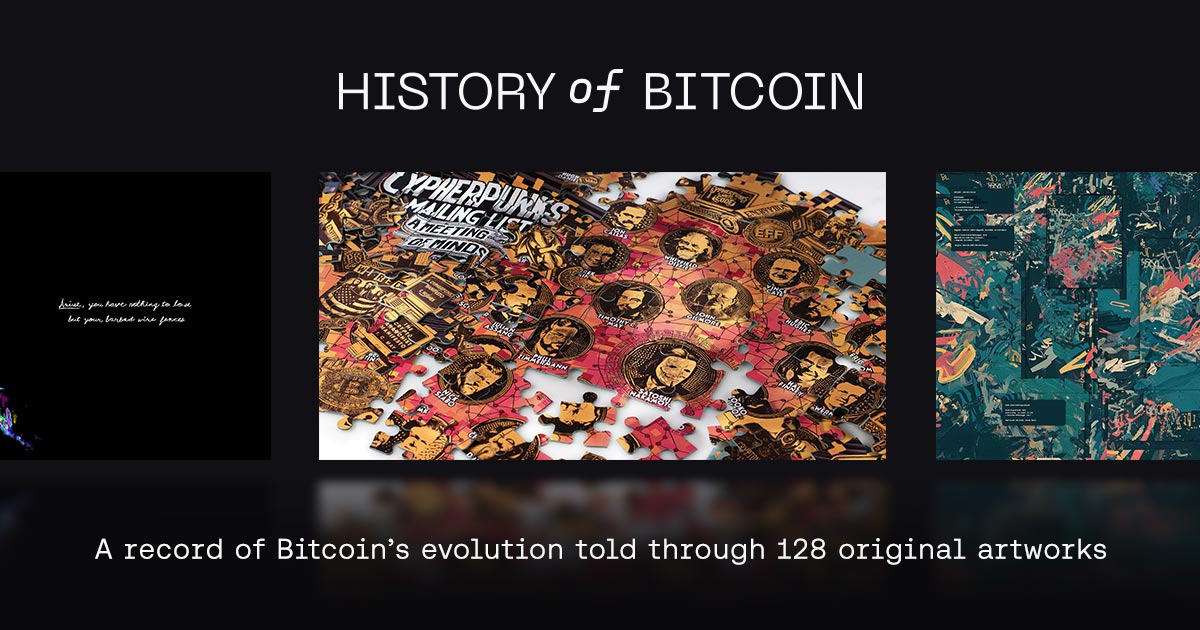
Before #Bitcoin, there were #Cypherpunks. A small group of hackers, cryptographers, and privacy activists came together around a simple mission: implement cryptographic protocols in software. They met around San Francisco and launched a mailing list that quickly became legendary – about 2,000 subscribers and around 2,000 emails a month. It turned into the main public forum to discuss the future of the internet and the Cypherpunk mission. As Eric Hughes wrote in A Cypherpunk’s Manifesto: “Cypherpunks write code.” And they did: anonymous remailers to hide email metadata PGP, giving people private communication online for the first time early experiments with electronic cash – digital money for anonymous use on the internet Some of the Cypherpunks whose work shaped this era: Nick Szabo, Adam Back, Igor Chudov, John Gilmore, Perry Metzger, Marc Andreessen, Vipul Ved Prakash and many more. We captured this moment in The History of Bitcoin by Smashtoshi with the artwork: “CYPHERPUNK: A MEETING OF MINDS” by Cypherpunk Now. It appears in the Collector’s Book and on our interactive timeline. Read the full article by Aaron van Wirdum:
Before #Bitcoin, there was crypto anarchy. Tim May watched his friend Phil Salin build AMIX – an early online marketplace for information. Salin imagined people buying guides, reports, software, expert advice. May thought bigger. The most valuable information wouldn’t be public reports, but secrets. Trade secrets. Classified documents. Information people would pay serious money for. He imagined “BlackNets”: encrypted markets where people operated under pseudonyms, traded information, and paid with electronic cash. Governments would try to kill it – but code running worldwide would be very hard to stop. May saw two futures: 1️⃣ A surveilled internet – every message, site and transaction logged. 2️⃣ A #cryptographic internet – strong crypto everywhere, individuals using electronic cash, reputation and proofs instead of trusting the state. That second path, he believed, would lead to crypto anarchy. In 1988 he wrote The Crypto Anarchist Manifesto and handed it out at Crypto ’88. A quiet beginning to the revolution Bitcoin would later ignite. We’ve captured this moment in The History of Bitcoin by Smashtoshi with the artwork “MAKING A MANIFESTO” by @nicedayJules overon X, featured in the Collector’s Book and our interactive timeline. Read the full article by Aaron van Wirdum here: 🔗 #Art #BitcoinArt #Zap ⚡️
Bitcoin didn’t start in 2009. You can trace its story back to 1979, when Ralph Merkle designed a #cryptographic data structure that would become one of #Bitcoin’s core building blocks: the #MerkleTree. Merkle first documented the idea in his thesis and patent. It wasn’t until CRYPTO ’87, an academic conference on advances in cryptology, that the work began to get broader recognition. From idea to spotlight took almost a decade. By the mid-1990s, Merkle trees were in production. One of the best examples: Surety, a company that hashed client documents into a Merkle tree and published the root hash in the New York Times classifieds each week, anchoring data integrity in full public view. Years later, when #SatoshiNakamoto needed a way to structure Bitcoin blocks that was both efficient and tamper-evident, he chose Merkle trees. In the #BitcoinWhitepaper, all transactions in a block are hashed into a Merkle tree, with only the Merkle root included in the block header. This keeps blocks compact and makes verification straightforward. Satoshi also noted that old blocks could be compacted by pruning spent transactions. Combined with Merkle proofs, this design choice enabled light clients to verify transactions without downloading full blocks, critical for Bitcoin’s scalability and global accessibility. Ralph Merkle likely imagined many applications for his invention, but he couldn’t have foreseen that his “tree” would help secure a trillion-dollar network. By extracting strong security guarantees from simple hashing, he gave Bitcoin a scalable root of trust. The artwork “Merkle Trees and the Roots of Trust” by Gina Choy pays tribute to this chapter of Bitcoin’s history. It appears in the History of Bitcoin Collector’s Book and on our interactive timeline. 📖 We’re telling Bitcoin’s origin story one building block at a time. Follow History of Bitcoin / Smashtoshi for more chapters from the early days of cryptography, cypherpunks and digital money. 🔗 View the full article here #BitcoinArt #Art #BitcoinTimeline #Zap ⚡️