Bitcoin: A Peer-to-Peer Electronic Cash System (Sort Of)
Or: The Day Baba Tried to Explain Satoshi's White Paper to Adam and Layla
By Adam, Age 14 (Digital Money Expert)
So, picture this: a Tuesday evening. Baba came home with this look on his face. Not the "someone ate my last samosa" look, but the "I'm about to teach you something important" look.
"Kids," he announced, setting down his briefcase. "Today we're going to read a very special document."
"Is it about video games?" I asked hopefully.
"Is it a permission slip for unlimited screen time?" Layla added.
"Better," Baba said, pulling out his laptop. "It's the Bitcoin Whitepaper."
Layla and I exchanged glances. Muezza meowed from under the table, which I'm pretty sure was cat-language for "this sounds boring."
Page 1: The Problem (Or: Why Banks Are Like That One Kid Who Has to Be in the Middle of Everything)
"Okay," Baba began, "imagine you want to send money to your cousin Zahra in another country."
"Easy!" I said. "I'll just hand her the money."
"She lives in Malaysia, Adam," Mama said, not looking up from her cooking.
"Oh. Right. So... I'll mail it?"
"What if it gets lost?" Layla asked. "Or stolen? Or what if Muezza somehow mails herself instead?"
We all looked at Muezza, who was currently trying to fit inside a box half her size. Fair point.
"Exactly," Baba said. "So normally, you'd use a bank. But here's the problem Satoshi Nakamoto—"
"Who?" I interrupted.
"The mysterious person who invented Bitcoin. No one knows who they really are. Could be one person, could be a group, could be an alien."
"Definitely an alien," I muttered. Layla rolled her eyes. She's been perfecting that move since she was, like, five.
"Anyway," Baba continued, "Satoshi noticed that when you send money through banks, they act as the middleman. They have to verify that you actually have the money, that you're not trying to spend the same money twice—"
"Why would anyone do that?" I asked.
"Because humans are creative in terrible ways," Mama called from the kitchen. "Now pay attention."
Page 2: The Solution (Or: What If We Could All Just... Agree?)
"So here's Satoshi's big idea," Baba said, getting excited. He always does this finger-tent thing when he's about to explain something he thinks is cool. "What if, instead of trusting ONE bank to keep track of everyone's money, we had EVERYONE keep track of EVERYONE's money?"
There was a pause.
"That sounds exhausting," Layla said.
"That sounds AWESOME," I said. "It's like... a group project for money!"
"Adam, you hate group projects," Layla reminded me.
"I know, but this is different! This is group projects with... mathematics!"
Baba laughed. "Exactly! Satoshi created something called a 'blockchain.' Think of it like a notebook that everyone has a copy of."
"Why is it called a blockchain?" I asked.
"Because information is stored in 'blocks,' and they're linked together in a 'chain,'" Mama explained, bringing over a tray of tea. "See? Block. Chain. Our ancestors were very literal people."
Page 3: The Transactions (Or: How to Send Money Without Actually Sending Money)
"Here's how it works," Baba said, drawing on a piece of paper. "When you want to send Bitcoin to someone, you announce it to everyone on the network."
"EVERYONE?!" Layla gasped. "That's so embarrassing! What if I want to buy something weird?"
"They don't know it's YOU-you," Baba explained. "You have a digital address, kind of like a username. So instead of 'Layla sent 1 Bitcoin to Adam,' it says something like 'XK893FJ sent 1 Bitcoin to QR473NM.'"
"Oh, so it's like having a spy code name!" I said. "I want mine to be ThunderBolt3000."
"That's not how it works, sweetie," Mama said gently. "It's random numbers and letters."
"ThunderBolt3000 is cooler," I insisted.
Page 4: The Timestamp Server (Or: Proof That You Did the Thing at the Time You Said You Did the Thing)
"Now," Baba continued, "the whitepaper talks about something called a 'timestamp server.' It's basically a way to prove that a transaction happened at a specific time."
"Why does that matter?" Layla asked.
"Because," Baba said, using his teaching voice, "what if someone tries to spend the same Bitcoin twice? Like, they send it to you, but ALSO send it to someone else at the same time?"
"That's cheating!" I exclaimed.
"Exactly. So the timestamp server helps everyone agree on which transaction came first. It's like when you and Layla both claim you called dibs on the last piece of cake—"
"I ALWAYS call it first," I interrupted.
"You do NOT," Layla shot back.
"—and we check the security camera to see who actually said it first," Mama finished.
"We have security cameras?" I asked.
"No, Adam. It was a metaphor."
Page 5: Proof-of-Work (Or: Why Bitcoin Miners Aren't Actually Mining)
"This is where it gets interesting," Baba said. "To add transactions to the blockchain, people called 'miners' have to solve really difficult maths puzzles."
"Wait," I said. "I thought miners went underground and dug for gold or diamonds or whatever."
"Different kind of mining," Mama explained. "These miners use powerful computers to solve complex mathematical problems. When they solve one, they get to add a new block of transactions to the chain."
"And they get paid Bitcoin for doing it!" Baba added.
"So let me get this straight," Layla said slowly. "People use powerful computers to solve maths problems that don't actually DO anything except prove they solved math problems, and they get paid for it?"
"Well, when you put it THAT way..." Baba trailed off.
"But it DOES do something," Mama said. "It keeps the network secure. The maths problems are so hard that it would take too much time and electricity to cheat the system."
"Ohhhh," I said, even though I only sort of understood. "So it's like... really expensive homework?"
"Sure, Adam," Baba sighed. "Really expensive homework."
Page 6: The Network (Or: Democracy, But Make It Maths)
"The network has a simple rule," Baba continued. "The longest chain wins."
"Like Rapunzel?" I asked.
Everyone stared at me.
"What? She had the longest chain of... hair. Okay, forget it."
Baba cleared his throat. "What I mean is, if there's ever a disagreement about which version of the blockchain is correct, the network accepts whichever chain has the most work put into it—usually the longest one."
"So if 51% of the computers agree on something, that becomes the truth?" Layla asked.
"Basically, yes."
"That seems... problematic," she said.
"It can be," Mama agreed. "That's why it's important that no single person or group controls more than 50% of the mining power. Otherwise, they could manipulate the system."
"Hypothetically," Baba added quickly, seeing our worried faces, "it would be extremely expensive and difficult to do."
Page 7: Privacy (Or: Everyone Knows Your Business, But They Don't Know It's YOUR Business)
"Now, about privacy," Baba said. "Remember how I said transactions use random addresses instead of names?"
We nodded.
"That means the blockchain is completely public—anyone can see every transaction that's ever happened—but they can't necessarily tell who made them."
"Like a mask!" I said. "You can see me running around, but you can't see my face!"
"If you're running around in a mask, we have other problems," Mama muttered.
"But," Layla said thoughtfully, "couldn't someone figure out who you are by looking at patterns? Like, if they know you bought something at one place, and then see a payment from that address to another address, couldn't they follow the trail?"
Baba looked impressed. "That's very perceptive, Layla. Yes, it's possible with enough detective work. That's why the whitepaper recommends using a new address for every transaction."
"So it's more like... privacy-ISH," I said.
"Privacy-ish," Baba agreed.
Page 8: The Calculations (Or: The Part Where Adam's Eyes Glazed Over)
"Now," Baba said, "there's a whole section about the mathematical probability of an attacker being able to—"
"BABA," I interrupted. "Do we REALLY need to know the math?"
"The whitepaper includes formulas about hash rates and proof-of-work chains and—"
"BABA."
He sighed. "Fine. The short version: Math makes Bitcoin secure. Very complicated math."
"I could've told you that an hour ago," Layla said.
Page 9: Conclusion (Or: What Did We Just Learn?)
Mama sat down with us, tea in hand. "So, what do you think? Do you understand what Satoshi was trying to do?"
"I think," I said slowly, "that Satoshi wanted to create money that no one person controlled. Like, instead of banks being in charge, everyone is kind of in charge together."
"And the blockchain is like a shared notebook," Layla added, "where everyone can see what's written, but it's really hard to cheat because you'd have to outwork everyone else."
"And miners solve math problems to add new pages to the notebook," I continued, "and they get paid Bitcoin for their trouble."
"And it's all transparent but also kind of private," Layla finished, "which is confusing but cool."
Baba beamed at us. "That's exactly right!"
"But Baba," I asked, "is Bitcoin... halal?"
He smiled. "Well, Adam, that's a different conversation. But understanding how it works is the first step."
Muezza chose that moment to jump onto the table, knocking over Baba's carefully drawn diagrams.
"Muezza!" we all shouted.
He just stared at us with his big green eyes, probably thinking about how silly humans are with their digital money and complicated maths problems.
And you know what? Maybe he had a point.
The End
(Or: The Beginning of Many More Questions About Bitcoin That Baba Would Have to Answer)
👉 Find out more in BITCOIN IS HALAL!
Bitcoin is Halal (English 🇬🇧):
📚Amazon (paperback):
https://amzn.eu/d/7G7lNQb
📱Google Play (ebook):
https://play.google.com/store/books/details?id=qjxlEQAAQBAJ
Bitcoin itu Halal (Bahasa Indonesia 🇮🇩):
📱 Google Play (ebook):
https://play.google.com/store/books/details?id=bqtyEQAAQBAJ
📚 Bukunesia (paperback):
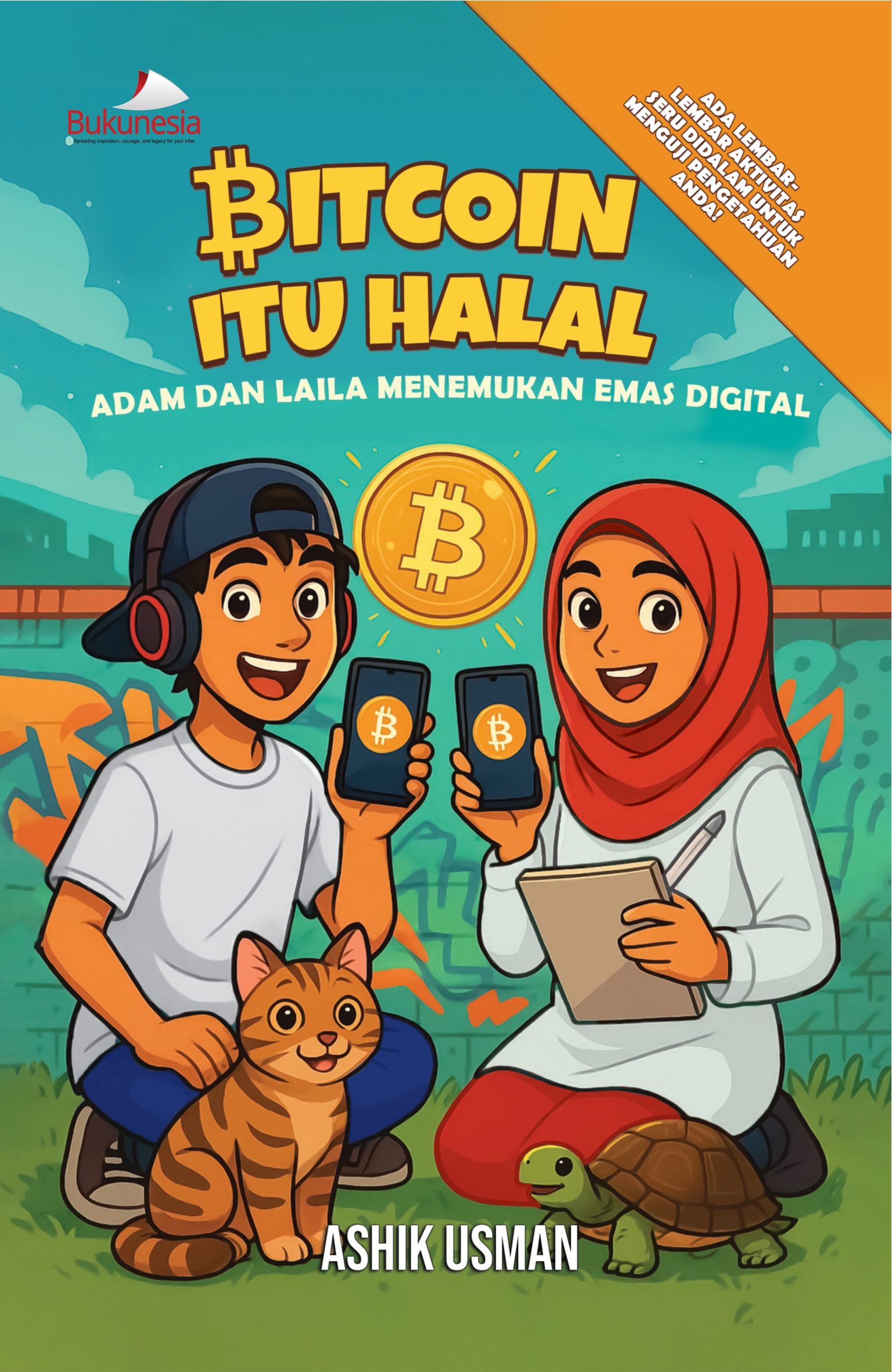
Bukunesia Store
Buku Bitcoin itu Halal Adam dan Laila Menemukan Emas Digital - Bukunesia Store
Dapatkan Buku Bitcoin itu Halal Adam dan Laila Menemukan Emas Digital hanya di Penerbit Bukunesia dan dapatkan dengan harga terbaik disini.
Or from here:
https://shopee.co.id/Bukunesia-Buku-Bitcoin-itu-Halal-Adam-dan-Laila-Menemukan-Emas-Digital-i.717921939.43673317510
Arabic translation coming soon! البيتكوين حلال
🇧🇦 Bosnian translation starting soon!
🎙️Audiobook is currently in development.
Thank you!🙏
🌐 More details on www.ashikusmanbooks.com
#BitcoinIsHalal #DigitalLiteracy #BitcoinForKids #BitcoinEducation #BitcoinWhitePaperDay


