Go on… drop your spam in here. We dare you πŸ•·πŸ“¬ #CreepItClean image
Resharing a recent investigation for anyone who may have missed it the first time πŸ‘‡ Back in April, we started tracking a sharp surge in phishing campaigns routed through residential proxy networks. Digging deeper, our analysis points to a persistent China-nexus threat actor focused predominantly on Japan πŸ‡―πŸ‡΅ Catch up on the full story, including what we’ve seen so far and what might come next πŸ•΅οΈβ€΅οΈβ€΅οΈ #Phishing #Botnet #Spam #Cybercrime image
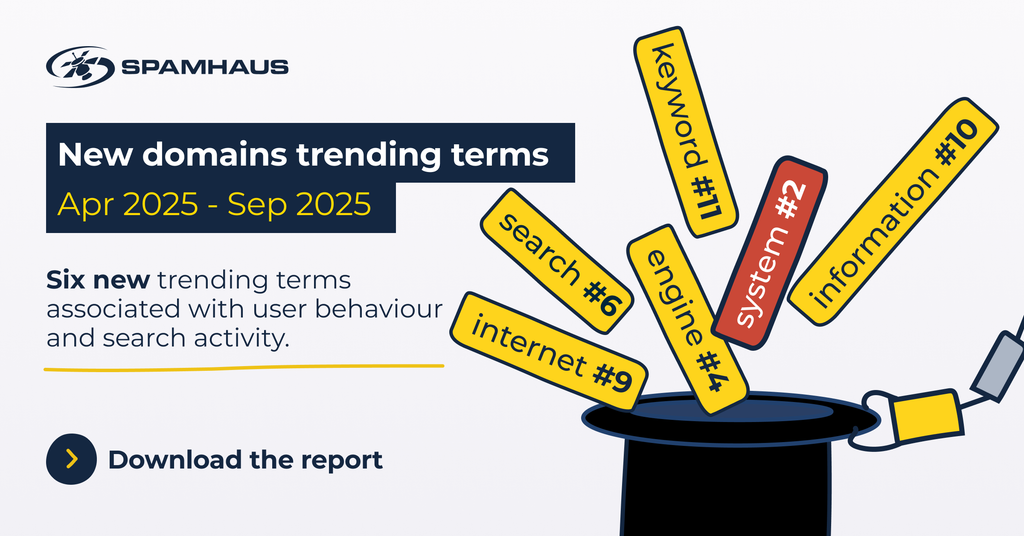
🌐 NEW DOMAIN TRENDING TERMS | 6 new entries linked to user behaviour and search activity: system (#2), engine (#4), search (#6), internet (#9), information (#10), keyword (#11). πŸ€– With algorithms shifting towards Large Language Models (LLMs), are we seeing an increase in black hat SEO activity? 🎩 Learn more in the latest #DomainReputation Update πŸ‘‡πŸ‘‡ #Phishing #DomainAbuse #LatestInsights image
πŸ“¨ Over the past 30 days, we’ve observed a sharp increase in spam-emitting IPs originating from four countries: #7 Russia – 149,352 detections (+76%) #8 Vietnam – 146,370 detections (+184%) #9 Morocco – 132,041 detections (+123%) #10 Pakistan – 127,542 detections (+93%) 🌏 Reputation Statistics | Countries πŸ‘‰ https://www.spamhaus.org/reputation-statistics/countries/spam/ Researchers are seeing πŸ‡―πŸ‡΅ Japanese residential proxy–based phishing with a slight evolution in tactics, to previously reported in a recent article: ‡️
🌐 DOMAIN REPORT APR - SEPT 2025 | 43.5 million new domains registered - 75% gTLDs - with .top (+94%) and .xyz (+103%) in theπŸ” 3 gTLDs. πŸ“ˆ Domains listed are up +48.3% 😱 ! One registry saw huge increases 🩳 πŸ”΅ - can you guess which one? πŸ”¦ Don't miss the Report Spotlight: β€˜TDS Abuse - What’s hiding behind the veil?’ Read the full report here ‡️ ‡️ #DomainInsights #CyberSecurity #Phishing #ThreatIntel image
Commencing April, we noticed a surge in phishing spam emissions leveraging residential proxy networks, akin by scale and speed to the heydays of botnet spam in the 2000s. πŸ“ˆ πŸ€– Looking closer, we assess this is a major shift of a persistent China-nexus threat actor predominately targeting Japan, emancipating themselves from disseminating phishing via subnets at several branches of China Telecom and China Unicom. ‡️ image
πŸ‡³πŸ‡± Netherlands-based Delft University of Technology (TU DELFT) has left itself wide open to abuse by spammers due to an open redirector vulnerability. Their site currently allows user-supplied href=parameters, meaning attackers can redirect visitors through TU DELFT's trusted domain to an external (and likely malicious) site (bskeklive[.]com), which then redirects again to another domain (cpofers[.]com), hosting X-rated content πŸ’‹πŸ€― You can find a safer demo here πŸ‘‰ https://etv.tudelft.nl/usm/interpret/link?href=https://www.spamhaus.org/⬇️