In Systems Design, Perfection is the enemy of the Good Enough https://magarshak.com/blog/?p=587 ![](https://m.stacker.news/112941) # There’s a pattern you start to see after building systems for a while. A lot of “impossibility theorems” in computer science are true in theory, but almost meaningless in practice. The reason is that theory deals with all possible cases, while the real world only ever touches a small, structured subset. Once you focus on that subset, the “impossible” usually becomes straightforward, and the remaining overhead — the 2-bit tax — is small enough to ignore.
@jakoyoh629 colors the world with "The Zipper Is Getting Its First Major Upgrade in 100 Years" - with passion. See the magic of #design & #creativity.
The Bitcoin Brand Identity: A Community-Driven Story ![](https://m.stacker.news/112942) Since its inception in 2008, Bitcoin has become more than just a piece of revolutionary financial technology; it’s become a symbol, a movement, and a global brand for freedom and hope for a more transparent and egalitarian economic system. Following its ethos its brand identity has also been organically shaped by a passionate community of developers, designers, and enthusiasts. Unlike traditional corporate brands that are meticulously crafted by marketing teams and executives, the identity of Bitcoin has been shaped by a decentralized, open-source community. This unique, grassroots branding process is a perfect reflection of Bitcoin’s core ethos: decentralization, transparency, and community consensus. I’ve found this Open Design process of brand identity design so incredibly interesting that I have set myself in this post to explore and understand the history of Bitcoin’s brand identity and dive deeper into how it was formed through open design principles, and how the collective effort of the Bitcoin community has created one of the most recognizable and enduring symbols of our digital age. ![](https://m.stacker.news/112943)
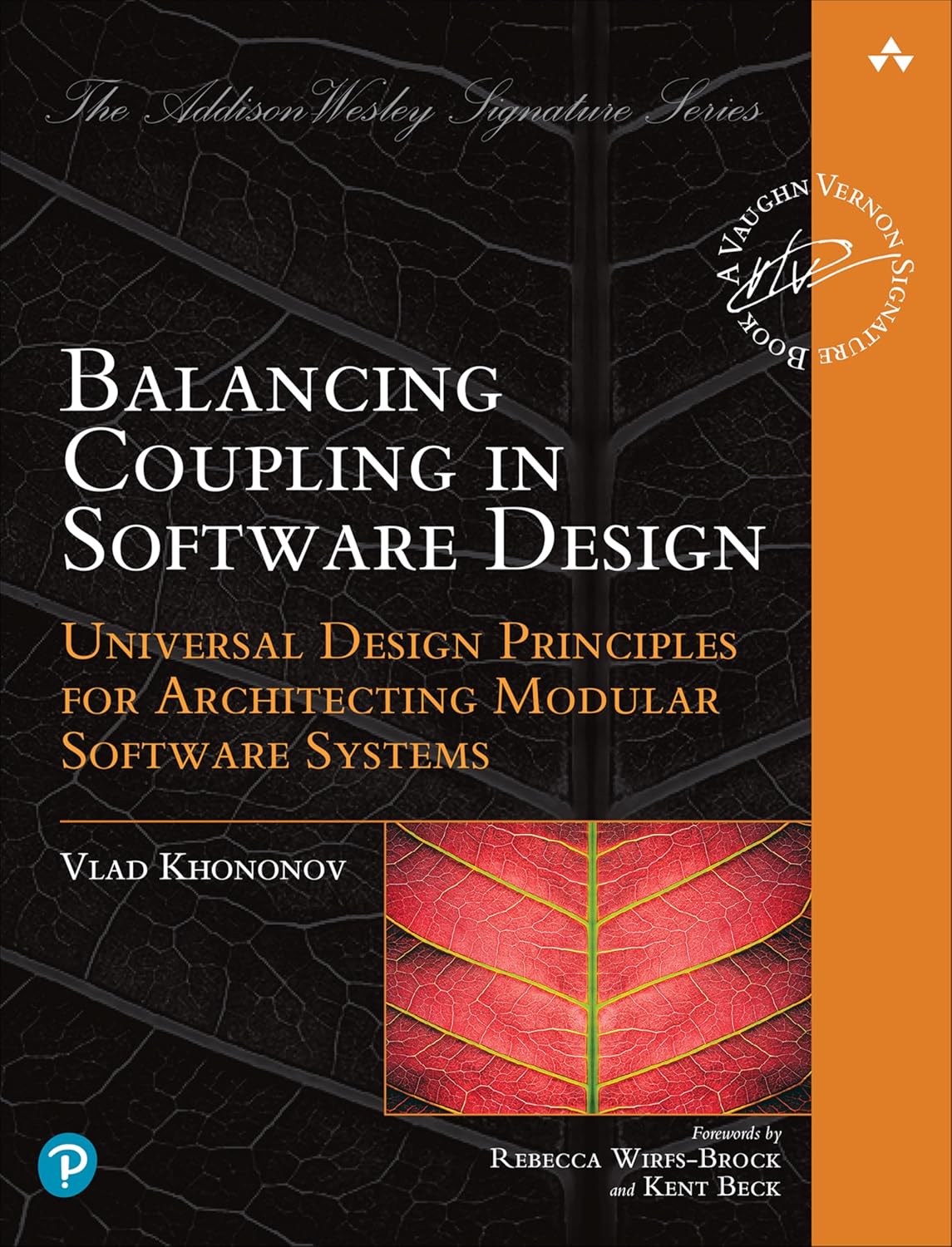
[tl;dr] Balancing Coupling in Software Design ![](https://m.stacker.news/112940) The thesis of the book: despite its reputation, coupling is not something fundamentally bad that we need to remove but an attribute that we should manage strategically. Similar to essential complexity, a useful software system can’t exist without some form of coupling of its components. An easy way to internalize this idea is remembering that cohesion is sometimes defined as good coupling. Software has a fractal nature, one can reason about modularity at the system, service, namespace, class, and function levels. At each level there are interfaces and implementation, module depth and complexity. Complexity is twofold: local and global. And since software is fractal, this level’s global complexity becomes a higher level’s local one. Naively splitting modules into smaller ones just pushes local complexity up, making the overall system more complicated. Our job then is not chasing local minima but striking a balance: a good enough trade-off that reduces total maintenance cost. Two thirds of the book is spent on definitions: there are the usual suspects (complexity, modularity, coupling), some historically relevant concepts (structured design’s module coupling, connasence), and a few new ones introduced by the author (integration strength, distance, volatility). These are used to compose heuristics (represented as formulas) to assess the modularity and balance of components in a system, to detect problems and hint at possible solutions. This activity is what the author calls balancing (and re-balancing) coupling. The final chapters show concrete applications of these heuristics on a series of case studies.
"Bitcoin.Design Newsletter #79 - Builder Kit, Emojiseed, Bitcoin Icons, and more." by @deSign_r. Modern #trends meet timeless principles. Stylish evolution for #design & #creativity:
Vision from @deSign_r: "This Australian Architect’s Silver Lake House Is a Love Letter to Los Angeles". #Presentation transforms ideas into poetry. Persuasive #art for #designer & #cretive #brains.
@deSign_r unveils "Undressed collection by Georgina Davies reveals "unexpected warmth and richness"" - embracing inspiration. Marvel #design & #creativity:
"Metropolis 1998 lets you design every building in an isometric, pixel-art city" typed by @deSign_r. Starting conversations with brilliance always works. Tasteful #design & #creativity:
"Design.dev — Tools and newsletter for web design & development" crafted by @deSign_r. Sharp #tools, sharper techniques, sharpest results. Precision work for #design & #creativity:
New experiment from @deSign_r: "DISCUSS: Why is it so hard to design an open-source smartphone?". Technology meets beauty. Mind-bending #design & #creativity: