Decentralizing Quality

Matt Ström-Awn
Decentralizing quality
Why moving judgment to the edges wins in the long run

**Decentralized quality means putting quality in the hands of workers, not managers.**
Before Frederick Taylor’s scientific revolution, quality emerged organically. Medieval guilds controlled craftsmanship through apprenticeships. Masters passed knowledge to workers, who earned the right to guarantee their work. A blacksmith’s reputation hung on each horseshoe; a baker’s livelihood relied on tomorrow’s bread being as good as today’s. Quality wasn’t imposed; it was inherited, practiced, and owned by workers.
Taylor’s industrial efficiency swept away these traditions but preserved the essential truth: those closest to the work know how to improve it. Even as scientific management took hold, alternative voices emerged. In the 1920s, Mary Parker Follett argued for participatory leadership, where workers shape their own processes through what she called ‘power with’ rather than ‘power over.’
Frank and Lillian Gilbreth challenged Taylor’s centralized approach by emphasizing the psychological aspects of work and worker welfare. Lillian’s 1914 work The Psychology of Management argued that effective management required understanding ‘the effect of the mind that is directing work upon that work which is directed, and the effect of this undirected and directed work upon the mind of the worker,’ advocating for approaches that considered individual worker needs and job satisfaction alongside efficiency.
# Quality is Job 1
In the early 1980s, Ford Motor Company launched the iconic slogan “Quality is Job 1.” It wasn’t just a marketing angle; it was a genuine commitment by Ford to improve vehicle quality, winning back consumers from global competition.
Foreign companies began to consistently outperform their American counterparts in quality rankings, customer satisfaction, and market share growth. In 1960, imports accounted for less than 5% of U.S. car sales. By 1971, they accounted for about 15%. By the 80s, foreign-made autos — mainly Japanese — reached over 30% of the U.S. market.
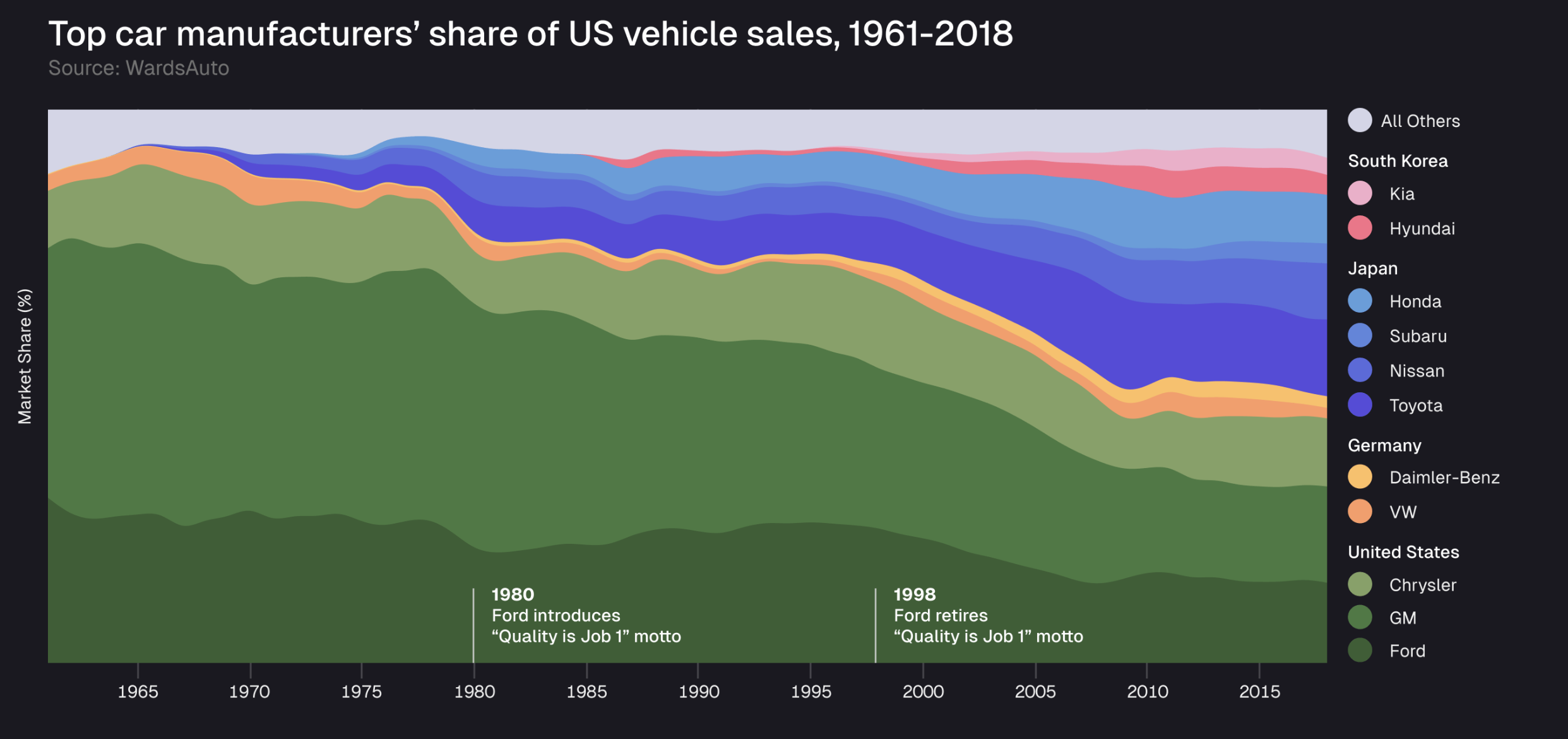
The popularity of trucks and SUVs in America gave executives and shareholders a false sense of security. American manufacturers like Ford were well-positioned to build and sell these kinds of gas-guzzling vehicles. Ford lost its appetite for quality reforms. In 1998, they stopped claiming that “Quality is Job 1.”5

Stacker News
Decentralizing Quality \ stacker news ~Design
A 1978 Ford Pinto Associated Press Decentralized quality means putting quality in the hands of workers, not managers. Before Frederick Taylor’s s...