Renaud Cuny

Renaud Cuny's avatar
Renaud Cuny
npub1gth6...3a7q
Proof of Work
A few months ago I still thought Core v30 would get delayed, or that fees alone would kill spam. I was wrong. So I dug into 18 months of blockchain data from my own node. Issue #1 of Bitcoin Block Space Weekly is out: - Marathon tested 1MB OP_RETURN payloads in May - 3 pools now rotating - 21% of nodes moved to Knots - 2 soft-fork proposals gaining traction renaudcuny.substack.com/p/bitcoin-block-space-weekly-issue
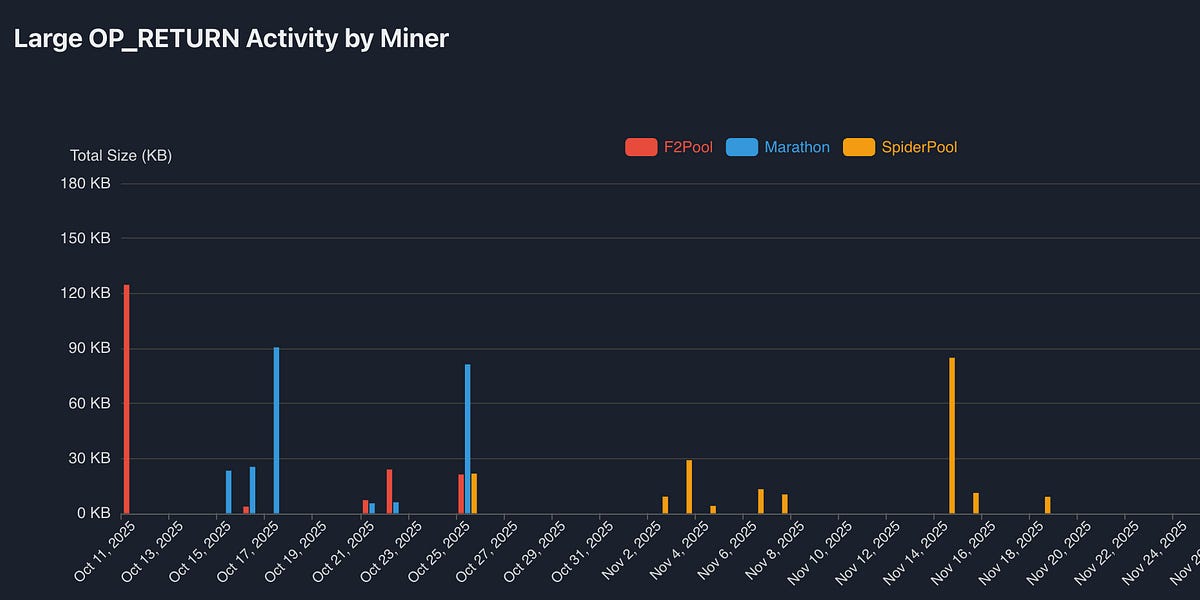
β€œv30 won't change much - miners already bypass policy with direct submission anyway." I tracked 3months OP_RETURN data to test that claim: - Before Oct 10: Minimal large OP_RETURNs - Oct 10: v30 is released - Same day: F2Pool mines a 97KB OP_RETURN. - After Oct 10: Clear increase. Who's doing this? F2Pool , Marathon, SpiderPool -> Combined 22-23% of the hashrate 23% of miners can turn 100% of nodes into large file (spam) storage devices. v30 relay policy enabled this. Consensus rules will fix it.
🧡 "Bitcoin is a ghost town" they say, pointing to quiet mempools But in the last 3 months, $60B+ moved on-chain daily on average That's 588,824 BTC flowing through the network every single day The "ghost town" crowd is measuring the wrong thing entirely... πŸ‘‡ 2/ Here's what's actually happening: While transaction COUNT dropped slightly, transaction VALUE remains massive: $60B+ daily on-chain transfers 4.3M BTC weekly (21.6% of total supply) Same volume levels as 5 months ago This isn't a ghost town - it's serious money moving seriously 3/ Plot twist: Bitcoin on-chain value often EXCEEDS daily spot trading volume June 11th example: 🟠 624,437 BTC moved on-chain βšͺ 467,791 BTC spot volume Real Bitcoin β†’ Real wallets vs. Paper trading β†’ Same coins recycling Which one matters more? πŸ€” 4/ What this actually signals: βœ… Less speculation, more actual utility βœ… Institutions moving capital quietly βœ… Bitcoin working as designed: final settlement layer βœ… Empty mempool = efficiency, not abandonment The network is maturing, not dying 5/ The "ghost town" narrative completely misses the point Bitcoin isn't about constant mempool chaos - it's about moving real value efficiently What other "obvious" metrics do you think tell incomplete Bitcoin stories? πŸ” Building tools to dig deeper into these questions
The Global Race for Bitcoin image One of the most interesting aspects Bitcoin is the game theory. Thanks to its unique characteristics (scarcity, decentralization, security, divisibility, portability, fungibility, transparency and more) Bitcoin is without a doubt a superior form of money. Yet, because it is still new, only a small portion of global population has adopted it. That's where game theory comes in: Every entity in the society (individual, family, communities, institutions, private companies, corporate, public sector, nation state) must make a choice: Shall I bet on that new form of money or rather stick with the current one? Individuals and entities choosing not to move run the risk of being left behind. Those who decide to move will enjoy the benefits of being early but also need to consider the risk (even if small) of Bitcoin being abandoned at some point for whatever reason. What's more, financial institutions that we'd expect to reject Bitcoin the most because of their privileged position, now have to carefully evaluate the risk of Bitcoin winning and them losing by joining too late. Could that explain the confusing messages we seem to be getting: On some TV channels we hear Blackrock's CEO selling the unique merits of Bitcoin and Bitcoin ETF, on the other hand we hear Jamie Dimon dismissing Bitcoin as a 'pet rock' that does nothing. Are these two really in disagreement or are they playing their own version of the game to confuse the populace while planning on getting as many Bitcoin as possible?