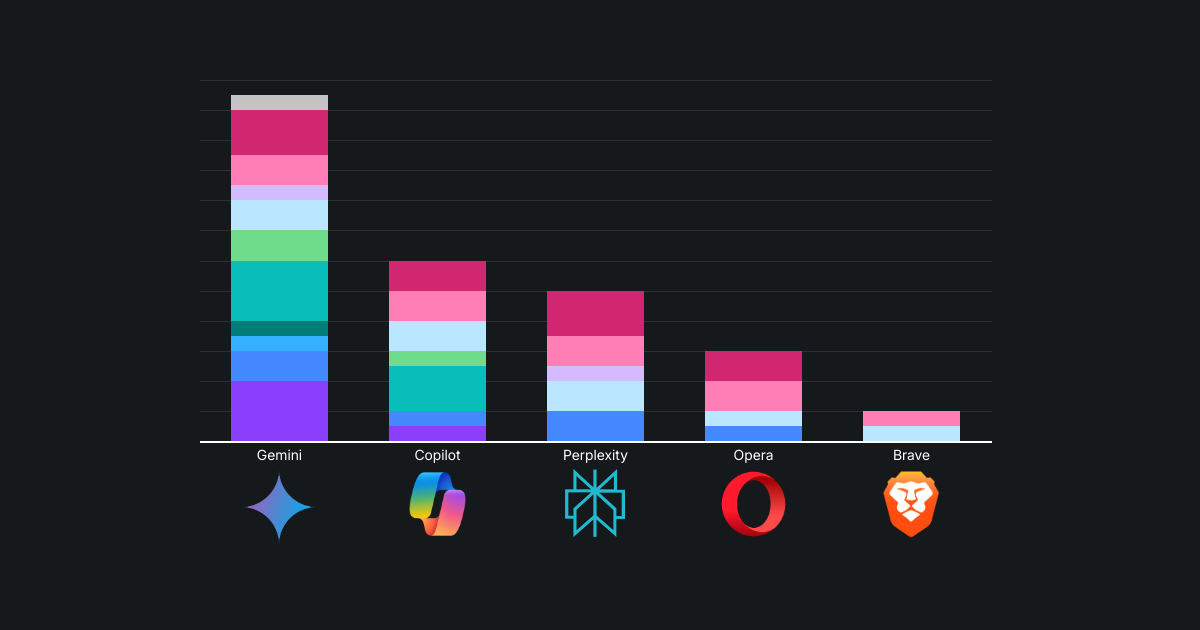
Which browsers with integrated AIs collect the most user data The big thing with using integrated AI within browsers is that you are potentially giving a lot more access to your user metadata versus just visiting the AIs webpage and doing a search there. The linked article measures across 23 different types of metadata and in case you think it is just harmless data, it includes data points such as your contacts, location (which can be precise), browser history (what you did in the past), purchases, identifying data (which can be used to build your profile of user behaviour across all the sites you visit), etc. Although we know that WhatsApp and Facebook already collect and even share this information with others (it is stated in their terms and conditions), many don't realise that allowing their browsers integrated AI to have this access, is potentially just as bad. From the Surfshark report, we can see that Google's data collection is at least as bad as Facebooks. One thing that is different is maybe that Google is not actually sharing that data to their partners (well, it is not stated as far as I know). But where this is of serious concern, is for political activists, whistle-blowers, or refugees, where there is a real danger of their governments being able to access this data, just because it is collected and stored. And of course, the contacts' info just helps to connect all the dots between everyone's contacts and friends... So, if you are in any sort of sensitive situation, you want to avoid browser integrated AI, and even consider rather using privacy respecting AI such as Venice or Proton's Lumo. See #technology #privacy #AI
Steam Client Adds Advanced Options to the In-Game Overlay for AMD & NVIDIA GPUs on Linux “The big news for Linux gamers is the implementation of advanced options for the in-game performance overlay for AMD and NVIDIA GPUs, improved Steam UI scaling in XWayland, improved system display scale in the in-game overlay, and improved Big Picture update progress UI. Also for Linux users, the new Steam Client update fixes several bugs, including an issue where the ‘Browse Local Files’ button in ‘Game Properties’ fails to open the system file browser, an issue where the Steam Client fails to reload or shows dialogs unexpectedly after a render process crash, and an issue with crash dump reporting.” Seeing that I have successfully migrated to Wayland, this was of a lot of interest to me. It is also good to see CPU temp added to the on-screen performance monitor. Once about 10 major game updates have finished downloading, I'll be able to try this out. Why are there always so many big updates ;-) See #technology #gaming #Linux #opensource
Mastodon social network is bringing quote posts to the Fediverse "Mastodon is officially rolling out quote posts. Starting next week, you’ll see an option to quote another user by selecting the repost — or “boost” — button, allowing you to add your thoughts to someone else’s post.” I know there were concerns about this, but it does seem to be the way to go. For influencers or bloggers, it does at least link back to their original post for attribution, which is important to them. It also seems users will have the option to disable it for their posts, so surely this choice to have or not have, is the best of both worlds. ActivityPub, which is what powers the Fediverse including Mastodon, is quite significant as it is an open standard and is probably the most used social network protocol outside of the centralised social networks such as Facebook, Twitter, Tumblr, etc. See #technology #Mastodon #socialnetworks
New Movie “Python: The Documentary” Traces the Language’s Story “Some things in the open-source ecosystem are absolutely foundational—they’ve shaped it into what we know today. One of the biggest is the Python programming language. And now, it’s giving its global community something a little different—and pretty exciting. A movie!” This is one of the most popular programming languages in the world, and known for its quirky sense of humour. The documentary should be entertaining to watch. There is a link to the movie in the linked article below. See #technology #Python #programming
A Love Letter To Internet Relay Chat — The Original Social Media That Is Still With Us Today “Although kids these days tend to hang out on so-called “Social Media”, Internet Relay Chat (IRC) was first, by decades. IRC is a real-time communication technology that allows people to socialize online in both chat rooms and private chat sessions. As a decentralized communication protocol, anyone can set up an IRC server and connect multiple servers into networks, with the source code for these servers readily available ever since its inception by a student, and IRC clients are correspondingly very easy to write.” Yep, even though it was the first, and was around before today's youngsters were even born, the fact is IRC is still around. With so many becoming disenchanted with all the trackers, adverts, high bandwidth requirements, and bloat of modern social networks, there is still IRC, and it works much the same as it did way back when. It's true, it is more a network that people escaped to, and not from. I actually use IRC daily, even if it is just posting to my own two channels I manage there. I also suspect that IRC will be around still long after other networks have disappeared. Not only that, but I'm just wondering if it won't get “rediscovered” by today's youth at some point, in the quest to find something simpler and more pure as a social network. There are quite a few IRC clients around, but something that may help with onboarding of brand-new users is also having a really user-friendly client that obscures some of the slash commands. I know IRC purists will turn their noses up at this, but remember attracting new blood also often means offering new interfaces. My channel is called #gadgeteerza and is on the Libera IRC server. If you want to try IRC out without installing a client or a server, you can just head to in your browser and try listing and joining channels. There is an interesting video to watch about IRC at the linked article below. See #technology #IRC #socialnetworks
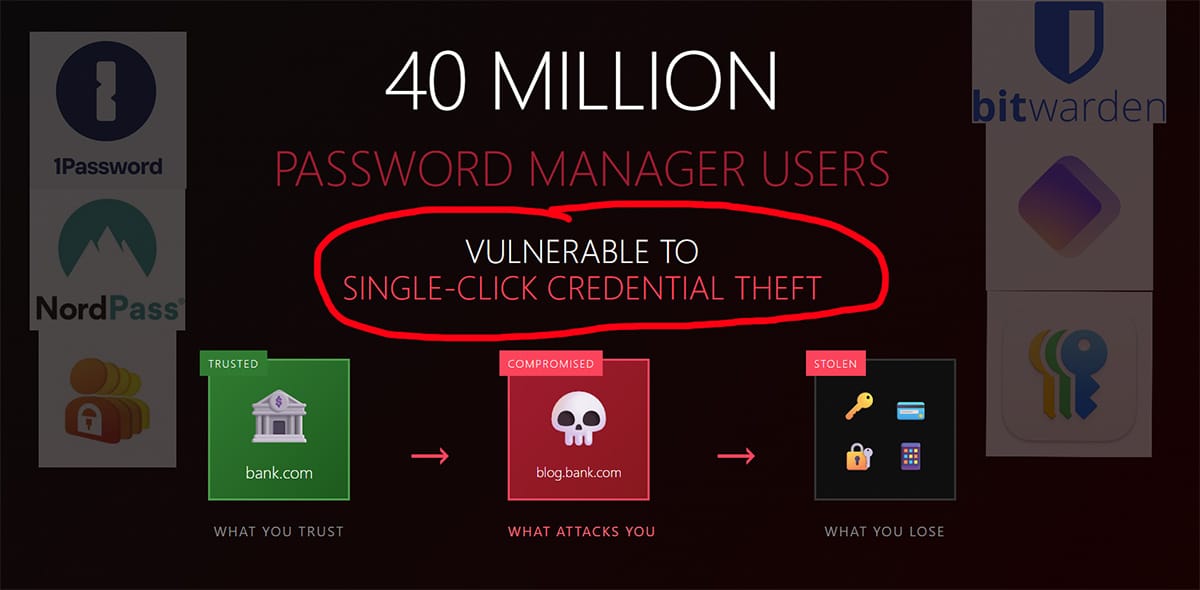
[URGENT] DEF CON Researcher Exposes How Password Managers Betray Your Trust "Czech security researcher Marek Tóth demonstrated at DEF CON 33 how a single click on any malicious website can steal passwords, credit cards, and 2FA codes from 40 million users of major password managers, with vendors like 1Password and LastPass refusing to fix the vulnerabilities." What this brings home yet once again is, in regard to security, the easier something is to use is usually not better for security. In this case, much of the issue is around the autofilling of passwords on page loading (because that is easier). So, to some extent, this is all helped along by settings we choose to set. Again for subdomains vs exact domain, it is easier to match to just the base domain… Many password managers will be addressing these issues in the coming week or two, but it is worth rethinking your "ease of use" settings on your password manager so long. See #technology #security #vulnerabilities
You can once again buy an official Commodore C64 "Basically, there is a whole gamut of ways to get some part of the C64 experience, ranging from emulator-only to a full hardware DIY or pre-assembled format. Each of which come with their own price tag, starting at $0 for running VICE on your existing system. With so much choice we can only hope that the renewed Commodore company will become something more than Yet Another C64 Experience." The video in the linked article gives a good run down of the various Commodore C64 options up to now, before ending with the details and cost of the revived "official" C64. Apart from holding the world record for the most microcomputer sales of all time. I had one as well, after my ZX81, and it was a major breakthrough with colour graphics, sound, etc. I have very happy memories from that C64, although I must say I did enjoy my Amiga 500 a lot more as the game quality was just that much better, and it had a lot of games. I still play some of those Amiga games today such as Ports of Call every now and again on my Linux PC using an emulator. So the question is, would there still be interest in 2025 for the C64? Well it certainly has been modernised a bit with regard to HDMI and peripheral support, and apparently many thousands of the unofficial C64s are still being sold. See #technology #Commodore #retrocomputing
Homepage - An Open Source Self-Hosted Dashboard Homepage is a modern, fully static, fast, secure fully proxied, highly customizable application dashboard with integrations for over 100 services and translations into multiple languages. Easily configured via YAML files or through docker label discovery. With features like quick search, bookmarks, weather support, a wide range of integrations and widgets, an elegant and modern design, and a focus on performance, Homepage is your ideal start to the day and a handy companion throughout it. My video explains why I moved from Heimdall to Homepage. It also shows what various service and information widgets are available, what my dashboard looks like, what the various parts do, and how the configuration files work. My docker compose file is also unpacked. Watch #technology #selfhosted #opensource #dashboard
Various desktop Linux tips for newbies I'm also seeing more and more new Linux users popping up. They're noticeable for often saying "why did they not do this earlier". The point is, today's Linux is very different from 20+ years ago. It generally just installs and works, often looking very similar to what users experienced before (meaning basically everything can be done in the graphical menus and windows). Linux gets a bit more interesting if you venture into using the AUR or Git versions of apps (you have to enable this, as these are more bleeding edge). This is where dependencies may break, and you need a bit of terminal skill often to fix things, but the good news is, you're not losing any data. Over the years I've also opted to having all my user data (the stuff under /home) in its own partition so that is it fully separate from the main OS. The reason was in the early years I used to format the drive and do clean installs, or was distro hopping. Nowadays, I just use Manjaro KDE, and it just keeps updating all then time - have not reinstalled for many years now (and no nagging to activate it or end of life coming). You may wonder what happens if a distro is no longer supported? Well firstly it keeps working, and it may well still pull some patches and updates. But usually you will be able to migrate to using some other distro, and your user data all stays intact. But this is also a good reason for picking one of the many mainstream distros, that should be around still for a very long time (measuring that long time in terms of Windows release cycles). No-one has to move to Linux, but for those curious enough to want to find out more, the usual approach is to start with a liveboot version and just run it from a USB stick or external drive to test it out a bit. The next step is typically to install it side-by-side with Windows, but I'd really recommend a separate hard drive, as Windows does some odd things to the boot partition sometimes. Linux can access the user data on a Windows drive, but I'd be careful with that, as Windows can lock the drive if it uses hibernation mode. The point is, lots of things are possible for Linux. One will find of course that many companies only bring out their software for Windows and macOS. And example is Stream Deck. But I discovered two excellent 3rd party apps that work even better under Linux with Stream Deck. Da Vinci Resolve for example produces world-class video editing software that runs on Linux natively, but there is also Kdenlive that will work just as well for most users. So always do a bit of research before buying software or hardware to choose wisely. Personally, for me, it's more about the freedom to what I want with it. See #technology #Linux #opensource
Using Signal groups for activism "Things are heating up. Millions of people are taking to the streets against Trump's rising authoritarianism. Communities around the US are organizing to defend against ICE raids, to protest Israeli genocide, for mutual aid, and for other forms of fighting fascism. Signal can help people safely organize in all of these contexts. Signal groups, in particular, are more powerful than you might be aware of, even if you already use them all the time. In the linked post you'll see how." Of course, activism is also about a much wider range of topics than the above, and many have been running for decades. Apart from activism in 1st Word Countries, there is also activism in many 3rd World Countries, which in many cases are really life and death situations if users are caught. Signal is not THE most private network around. There are many others like Threema (not public link group invites though) and SimpleX (really open group invites with custom names per group) that enable far more anonymity. In other words, they don't require any form of registration or a mobile number to work, meaning there is even less to link back to any individual user. But this is why I wanted to make this post. It often comes back to many people wanting to find their friends on their chat app. Yes, finding friends makes communicating easier, but that in itself does leak metadata. The reason I only have two or three contacts on Threema and SimpleX are that it is way more difficult to build out your network. This is where Signal does strike an excellent middle path - it is simpler to use and find friends, whilst also going as far as it can to guard your privacy. It has some good group options (including an announcements only group) and most importantly where it differs from WhatsApp and Telegram, are that it's metadata cannot be accessed by Signal (WhatsApp goes as far as actively sharing users metadata with advertisers and partners, which is why WhatsApp has so many businesses on board). Telegram may handle far bigger numbers for its groups, but the problem is users do need to set up their privacy settings very carefully, and their metadata is at the risk of being subpoenaed now, and of course Telegram's encryption is proprietary. Signal's groups are limited to 1,000 users, and another issue may be that there is one profile across all groups (unlike SimpleX where you choose a name for each group you belong to, but it does not scale well to large groups at all). Signal does hit a sweet spot though and should really be adopted by a lot more mainstream users. Signal's user privacy is way ahead of both WhatsApp and Telegram, yet it is just as easy and intuitive to use. But, as I mentioned above Signal is not perfect. To summarise those shortcomings, they are: 1. Even announcement-only groups are limited to 1,000 users (Telegram has 200,000 for normal groups and unlimited users for broadcast groups). 2. A phone number is required to register the account initially (SimpleX and Threema do not require anything). 3. The profile your friends see is the same profile seen in a group (SimpleX allows different names) so select your profile name with this in mind, although the phone number is hidden by default. See #technology #privacy #chatapps #activism