**Fediverse Report – #135**
Last week I wrote an article about Bluesky, political violence and how language is actively being shaped in a way that sets up for a potential future crackdown on Bluesky by the authoritarian regime. The article is on the surface about Bluesky, but I think it is relevant to the fediverse as well. The main idea is that the open social networks are actively being framed as a place for ‘left’ people and democrats, while at the same time there are louder calls for the US government to crack down on all left and democratic spaces. Furthermore, an [article]( ) by the Federalist lays out what strategy might likely be used: leverage the control over the app stores.
 The NewsMastodon is [launching]( ) paid services to make money beyond donations and grants. The company will now offer hosting, moderation, and support services for organisations that want their own servers on the fediverse. The new services target organisations that want their own presence on the fediverse, but lack the operational capacity to manage a Mastodon server. Mastodon will handle server setup and maintenance, and optionally provide moderation services as well. The organisation says this will create steady income while keeping their donation-based model.
This new service is mainly targeted at institutions, and so far, Mastodon has onboarded three government agencies. The most high profile is the European Commission’s Mastodon server, as well as a German state and a French city. In the announcement post, the organisation is clearly aware of the potential criticism of how this might interfere with goals of decentralisation. But with the number of fediverse servers in the tens of thousands, the fediverse is in a state where onboarding a additional institutions via managed servers will likely increase, not decrease, the resilience of the network. My personal observation working with the onboarding of governmental organisations in the past is that one of the main barriers is that of institutional capacity. Even when a government organisation has decided they want to have a presence on the fediverse, a significant amount of the challenge in getting there is figuring out internal responsibilities and capabilities. Virtually no (government) organisation has experience with handling these new types of questions, like how to handle moderation for example. As the fediverse grows and it becomes normalised for organisations to run their own fediverse server to handle their social networking presence, organisations can build up institutional capacity to easily run their own server. In the meantime, Mastodon’s new service can bridge the gap for organisations who want to build their own independent social networking presence, but does not have the capacity to manage everything that this entails.
[Gaza Verified]( ) is a grassroots initiative in the fediverse to verify the accounts of Palestinians in Gaza. The ongoing genocide in Gaza has lead to Palestinians to internet platform for fundraising and donations. This in turn has also caused scammers to take advantage of the situation by creating fake accounts pretending to be Palestinians and create [scam fundraisers](
The NewsMastodon is [launching]( ) paid services to make money beyond donations and grants. The company will now offer hosting, moderation, and support services for organisations that want their own servers on the fediverse. The new services target organisations that want their own presence on the fediverse, but lack the operational capacity to manage a Mastodon server. Mastodon will handle server setup and maintenance, and optionally provide moderation services as well. The organisation says this will create steady income while keeping their donation-based model.
This new service is mainly targeted at institutions, and so far, Mastodon has onboarded three government agencies. The most high profile is the European Commission’s Mastodon server, as well as a German state and a French city. In the announcement post, the organisation is clearly aware of the potential criticism of how this might interfere with goals of decentralisation. But with the number of fediverse servers in the tens of thousands, the fediverse is in a state where onboarding a additional institutions via managed servers will likely increase, not decrease, the resilience of the network. My personal observation working with the onboarding of governmental organisations in the past is that one of the main barriers is that of institutional capacity. Even when a government organisation has decided they want to have a presence on the fediverse, a significant amount of the challenge in getting there is figuring out internal responsibilities and capabilities. Virtually no (government) organisation has experience with handling these new types of questions, like how to handle moderation for example. As the fediverse grows and it becomes normalised for organisations to run their own fediverse server to handle their social networking presence, organisations can build up institutional capacity to easily run their own server. In the meantime, Mastodon’s new service can bridge the gap for organisations who want to build their own independent social networking presence, but does not have the capacity to manage everything that this entails.
[Gaza Verified]( ) is a grassroots initiative in the fediverse to verify the accounts of Palestinians in Gaza. The ongoing genocide in Gaza has lead to Palestinians to internet platform for fundraising and donations. This in turn has also caused scammers to take advantage of the situation by creating fake accounts pretending to be Palestinians and create [scam fundraisers]( ). This creates a challenge for moderation teams, for whom it is [challenging]( ) to figure out how to know if you are dealing with a real or scam fundraiser. Gaza Verified aims to help by having people known within the fediverse community have Signal video calls with the accounts of Palestinians on the fediverse, as well as keeping regularly in touch with them. In turn they use the Mastodon verification system to provide credibility. The Gaza Verified project also held a general fundraiser for all the Gaza Verified people, [raising more than 22k USD]( ).
PieFed 1.2 [update](
). This creates a challenge for moderation teams, for whom it is [challenging]( ) to figure out how to know if you are dealing with a real or scam fundraiser. Gaza Verified aims to help by having people known within the fediverse community have Signal video calls with the accounts of Palestinians on the fediverse, as well as keeping regularly in touch with them. In turn they use the Mastodon verification system to provide credibility. The Gaza Verified project also held a general fundraiser for all the Gaza Verified people, [raising more than 22k USD]( ).
PieFed 1.2 [update]( ) includes a variety of new features, including support for events and the ability to be reminded about a post in the future. It also allows admins to restrict NSFW content in certain countries. This helps with compliance for age verification laws, such as the UK’s OSA.
[Best-o-Masto](
) includes a variety of new features, including support for events and the ability to be reminded about a post in the future. It also allows admins to restrict NSFW content in certain countries. This helps with compliance for age verification laws, such as the UK’s OSA.
[Best-o-Masto]( ) is an alternative Mastodon client with a limited and specific purpose: “When you open the app, it shows you the 20 most popular posts from accounts you follow in the last few hours. You can favourite those posts, boost them, or open them in a real Mastodon client, and that’s about it.” Best-o-Masto is available for iOS and iPadOS for free.
[Flare]( ) is a new open source client that combines all open social networks into a single client. Flare supports Mastodon, Bluesky, Misskey, and RSS. It cannot yet combine all those post into a single unified timeline, a feature that is still on the roadmap. This compares to a similar app like [Openvibe](
) is an alternative Mastodon client with a limited and specific purpose: “When you open the app, it shows you the 20 most popular posts from accounts you follow in the last few hours. You can favourite those posts, boost them, or open them in a real Mastodon client, and that’s about it.” Best-o-Masto is available for iOS and iPadOS for free.
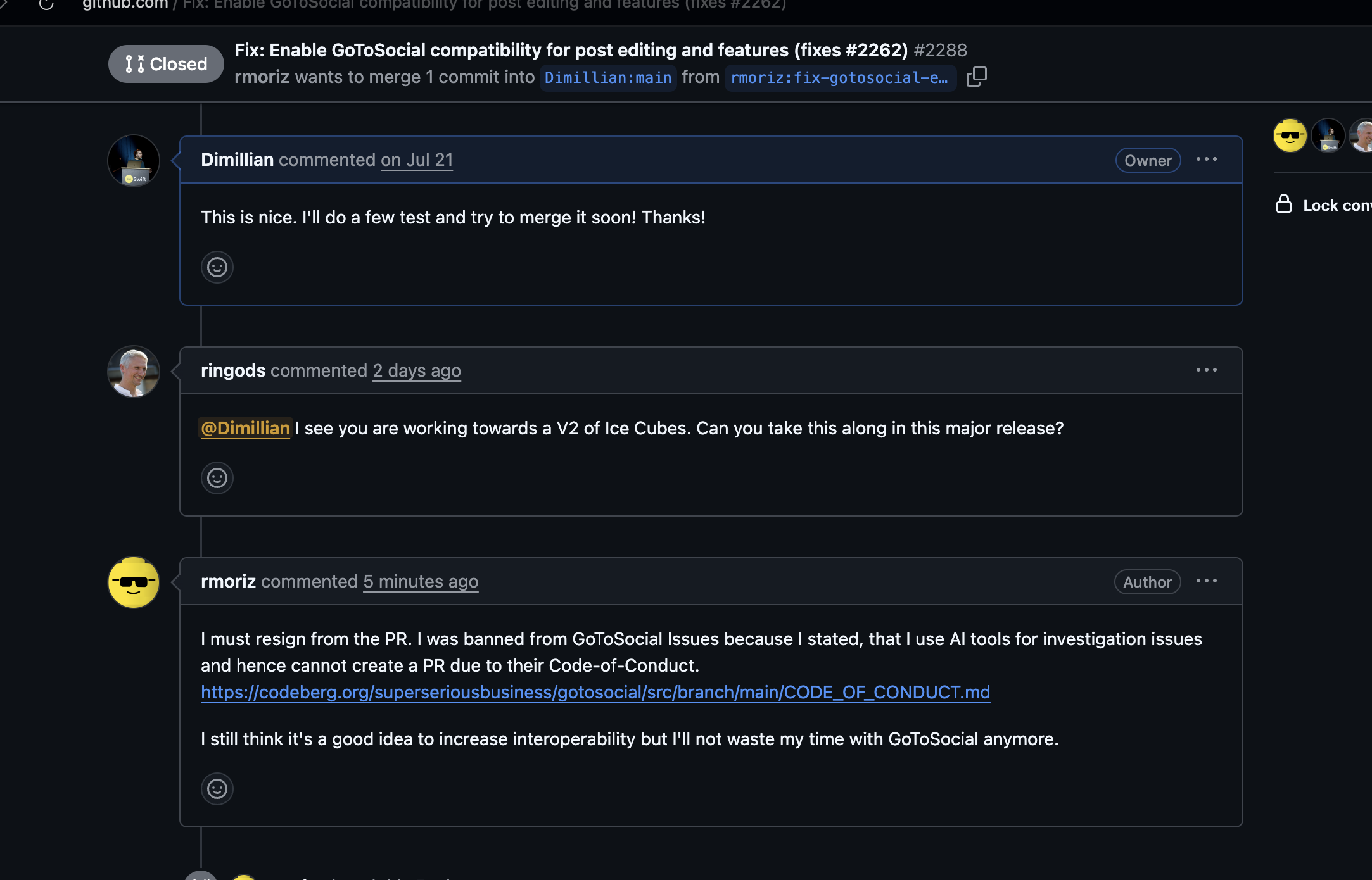
[Flare]( ) is a new open source client that combines all open social networks into a single client. Flare supports Mastodon, Bluesky, Misskey, and RSS. It cannot yet combine all those post into a single unified timeline, a feature that is still on the roadmap. This compares to a similar app like [Openvibe]( ), which also supports Nostr and Threads. Flare also has a local history, where it saves posts from your feeds locally, which can then be searched by you later. This feature, of saving posts locally for search, caused a great amount of in early 2023 in the fediverse with [Searchtodon](https://searchtodon.social/Adventures-in-Mastoland.html ). How this feature in Flare will be perceived now, 2,5 years later, might be a good indication if values have shifted on the fediverse.##
The Links<li>The German minister of Digitalisation <a href="https://social.bund.de/@BMDS/115231008702916101">addresses the Mastodon community</a> in a short video.</li><li>The <a href="https://catodon.social/notes/acw8haqar91a1s9d">Catodon project is shutting down</a>. Catodon was a fork-of-a-fork of Misskey, and the announcement post has more details on the background of the project as well.</li><li>PeerTube latest app <a href="https://framapiaf.org/@peertube/115247835478732259">update</a> allows you to download videos.</li><li><a href="https://mitra.social/post/01996401-5448-91c3-6b99-781bc3b76916">This week’s fediverse software updates.</a></li><li><a href="https://hackers.pub/@cocoa/2025/how-to-build-a-simple-activitypub-reminder-bot-in-python">How to Build a Simple ActivityPub Reminder Bot in Python</a>.</li>
), which also supports Nostr and Threads. Flare also has a local history, where it saves posts from your feeds locally, which can then be searched by you later. This feature, of saving posts locally for search, caused a great amount of in early 2023 in the fediverse with [Searchtodon](https://searchtodon.social/Adventures-in-Mastoland.html ). How this feature in Flare will be perceived now, 2,5 years later, might be a good indication if values have shifted on the fediverse.##
The Links<li>The German minister of Digitalisation <a href="https://social.bund.de/@BMDS/115231008702916101">addresses the Mastodon community</a> in a short video.</li><li>The <a href="https://catodon.social/notes/acw8haqar91a1s9d">Catodon project is shutting down</a>. Catodon was a fork-of-a-fork of Misskey, and the announcement post has more details on the background of the project as well.</li><li>PeerTube latest app <a href="https://framapiaf.org/@peertube/115247835478732259">update</a> allows you to download videos.</li><li><a href="https://mitra.social/post/01996401-5448-91c3-6b99-781bc3b76916">This week’s fediverse software updates.</a></li><li><a href="https://hackers.pub/@cocoa/2025/how-to-build-a-simple-activitypub-reminder-bot-in-python">How to Build a Simple ActivityPub Reminder Bot in Python</a>.</li>

The Federalist
We Can Give No Clemency To The Assassination Left
This week, conservatives were bludgeoned, once again, by the reality that they live in a country full of people who want them dead.
connectedplaces.online
‘Blueskyism’, Political Violence, and Open Social Networks Under Authoritarianism
After Kirk's murder, calls for censorship and the crackdown on political places started to include Bluesky. Open social networks must now figh...
Mastodon Blog
Service offerings from Mastodon
We
Gaza Verified
We’ve personally had video conversations on Signal with the people from Gaza whose Mastodon accounts on the fediverse are listed here and we veri...
Sakurajima (桜島)
s(ere) 🍉 :verified: (@s@sakurajima.moe)
Attached: 4 images
There's a scam that has been around in Bluesky. Now it's infecting Mastodon.
Someone is claiming they (or their relative) have...
Aral’s fediverse server
Aral Balkan (@aral@mastodon.ar.al)
To fediverse admins:
If you see an attempt to create a copy of a Gaza Verified member’s account on your server, without having heard from me fir...
Gaza Verified
Emergency appeal to get the Gaza Verified families stuck in the danger zone in the North to relative safety in the South.
PieFed 1.2 is released
#UI
Bottom sticky menu on mobile
**Instance-chooser** during registration, displaying info about all other instances
**3D rotating tag c…
Birchtree
Introducing Best-o-Masto
TLDR
Best-o-Masto is an alternative Mastodon client that does very little, but on purpose. When you open the app, it shows you the 20 most popular...
Flare - 聚合你的所有社交信息流
Openvibe — Town Square for Open Social Media
Interact With Anyone On The Open Internet. All Decentralised Social Networks, Single Timeline.
connectedplaces.online
Fediverse Report – #135
Mastodon launches a server hosting service, Gaza Verified is a project to verify Palestinians who need aid, and more.