**Fediverse Report – #134**##
The NewsMastodon is finally [introducing]( ) quote posts to their software, with the feature rolling out next week to the servers managed by Mastodon itself, and becoming available in Mastodon 4.5 soon after. Mastodon always had a significant worry that quote posts would lead to ‘dunking’ behaviour, where people would quote post someone else for clout. This is visible in how Mastodon has implemented the feature, and how their blog posts introduces the feature: it sees quote posts as a powerful tool that can easily be misused. That is why Mastodon has focused on giving users control over who can quote their posts; you can select per post if you want nobody, everybody, or only your followers to be able to quote your posts. You are also able to change this after you’ve made a post and somebody quotes your post in a manner you are do not want. In that case you can remove your original post from the other person’s quote post.
Giving people more control over how their data can be used is a great thing, and Mastodon adding quote posts in a manner that allows for people to determine how and if their posts can be quoted is a good implementation choice. Mastodon’s concern regarding the potential for harm with dunking does need some context however, researcher Hilda Bastian has a [highly detailed overview]( ) of over 30 studies on quote posts on Twitter and their impact. Bastian notes: “There’s conflicting evidence on whether QTs increase or decrease incivility, and whatever effect there is, it doesn’t seem to be major.” Bluesky added a[ similar feature for quote posts](
 ) in summer 2024, also allowing people to select when their posts can be quoted, and also described them as anti-toxicity features. I’m not aware of any study on how this feature on Bluesky affected toxic behaviour.
Bridgy Fed, the software that connects ActivityPub with Bluesky’s AT Protocol, has gotten a new [feature](
) in summer 2024, also allowing people to select when their posts can be quoted, and also described them as anti-toxicity features. I’m not aware of any study on how this feature on Bluesky affected toxic behaviour.
Bridgy Fed, the software that connects ActivityPub with Bluesky’s AT Protocol, has gotten a new [feature]( ) where you will get notified of interactions from non-bridged accounts. When you ‘bridge’ your account, it allows people on the other social network to interact with your posts. When someone replies to you on the other protocol, and they also have your account bridged, the replies show up on your posts, as if you were interacting with each other over the same protocol. But if the other person on the other network replies to a post, and they have not bridged their account, these replies are not visible, as they’ve not consented to getting their data send out on the other protocol. As such it becomes easy to miss interactions with your post that happen on the other protocol.
A New Social, the organisation behind Bridgy Fed, has launched an update where you will now get an hourly digest DM with links to the interactions on the other network. And if you do not want to receive the DMs, you can alter this in the [Bridgy Fed settings page](
) where you will get notified of interactions from non-bridged accounts. When you ‘bridge’ your account, it allows people on the other social network to interact with your posts. When someone replies to you on the other protocol, and they also have your account bridged, the replies show up on your posts, as if you were interacting with each other over the same protocol. But if the other person on the other network replies to a post, and they have not bridged their account, these replies are not visible, as they’ve not consented to getting their data send out on the other protocol. As such it becomes easy to miss interactions with your post that happen on the other protocol.
A New Social, the organisation behind Bridgy Fed, has launched an update where you will now get an hourly digest DM with links to the interactions on the other network. And if you do not want to receive the DMs, you can alter this in the [Bridgy Fed settings page]( ), or with a simple ‘mute’ as a reply.
The .world cluster is a group of fediverse servers all managed by FediHosting Foundation. The cluster contains servers such as the mastodon.world server and the lemmy.world server, which makes it one of the largest admins of fediverse users. The organisation shared an [update](
), or with a simple ‘mute’ as a reply.
The .world cluster is a group of fediverse servers all managed by FediHosting Foundation. The cluster contains servers such as the mastodon.world server and the lemmy.world server, which makes it one of the largest admins of fediverse users. The organisation shared an [update]( ), where they announced that they’ve expanded with a new piefed.world server. They also gave an update on their finances, with costs around 2000 USD per month, but income having dropped to around 1300 USD due to less donations. As the .world cluster of servers represents a significant portion of the fediverse, and contains the largest threadiverse server with lemmy.world, the financial health of the cluster is worth paying attention to.
A small piece of news that I think is worth highlighting: the iOS client IceCubes will [not have support](
), where they announced that they’ve expanded with a new piefed.world server. They also gave an update on their finances, with costs around 2000 USD per month, but income having dropped to around 1300 USD due to less donations. As the .world cluster of servers represents a significant portion of the fediverse, and contains the largest threadiverse server with lemmy.world, the financial health of the cluster is worth paying attention to.
A small piece of news that I think is worth highlighting: the iOS client IceCubes will [not have support](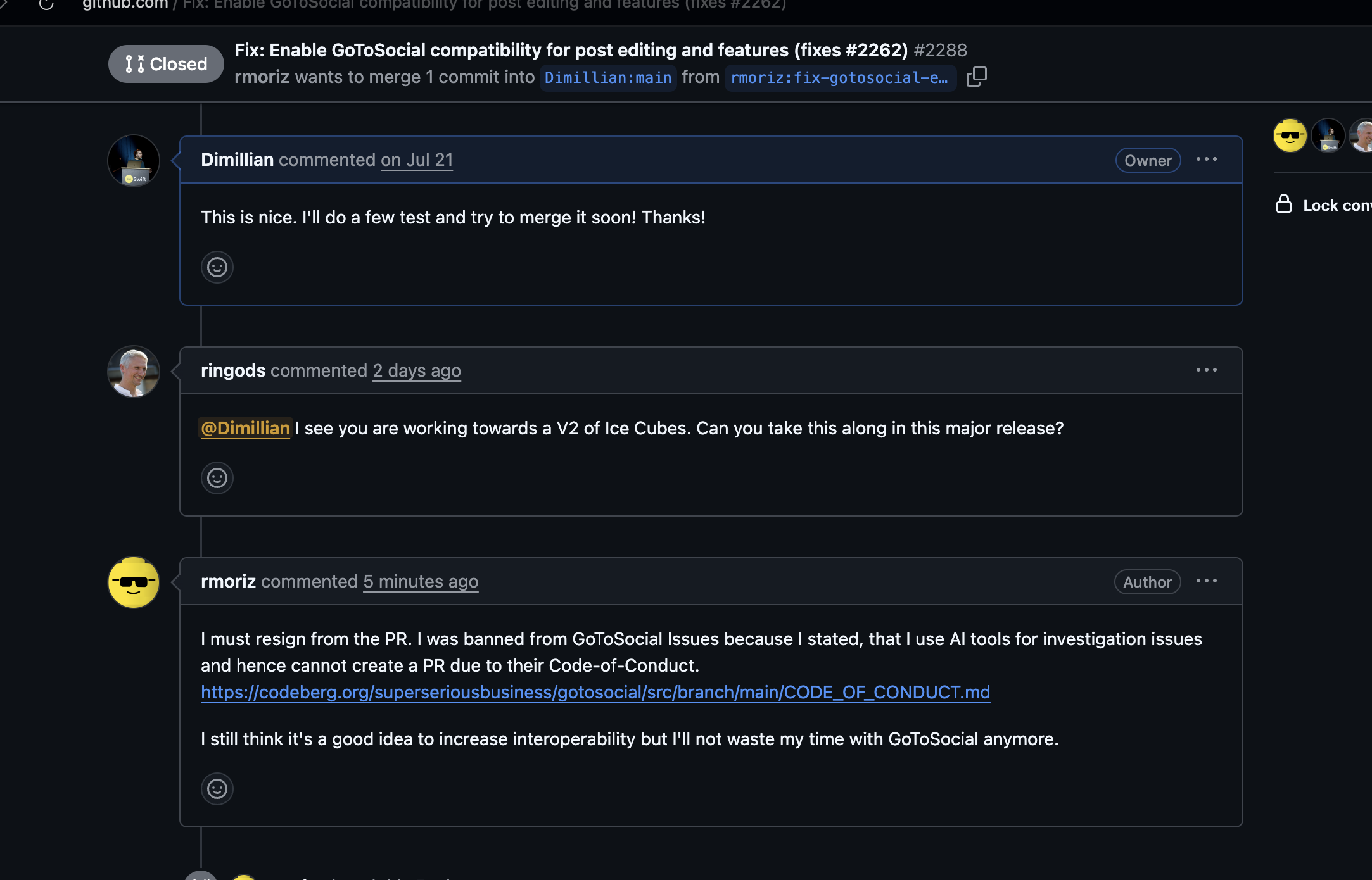 ) for the GoToSocial software, because the GoToSocial Code of Conduct prohibits contributions that are generated by AI. Every software is political in some form, and fediverse software makes the political aspect of software much more explicit. The fediverse talks about the plural politics of people often in terms of servers and moderation. By having many different servers, people can join the community that they align with. What’s interesting to me about this disagreement between GoToSocial and IceCubes is that this can extent to software itself as well. There is value in having multiple different clients that all offer roughly the same function, and having multiple different microblogging platforms that all do the same thing of posting. Software is political, and that people can express their politics via the software they choose is a good thing about the fediverse.##
The Links<li><a href="https://blog.joinmastodon.org/2025/09/trunk-tidbits-august-2025/">Mastodon’s monthly engineering update, Trunks & Tidbits, for August 2025.</a></li><li><a href="https://mitra.social/post/01993fe3-2dac-3533-6a81-9e653c9d94e0">This week’s fediverse software updates.</a></li><li>An <a href="https://pc.cafe/@fedicat/115186898466034123">updated list</a> of all 37 Mastodon iOS apps that are currently actively maintained on the Apple App Store.</li><li>The Fireside Fedi show t<a href="https://video.firesidefedi.live/w/q3z3C6JrpitEUxwFmwiTUo">alks with NodeBB creator Julian Lam</a>.</li><li><a href="https://joinpeertube.org/news/release-7.3">PeerTube v7.3 is out</a>, and it adds additional customisation features for admins, as well as the ability to schedule live streams.</li>#nlnet
) for the GoToSocial software, because the GoToSocial Code of Conduct prohibits contributions that are generated by AI. Every software is political in some form, and fediverse software makes the political aspect of software much more explicit. The fediverse talks about the plural politics of people often in terms of servers and moderation. By having many different servers, people can join the community that they align with. What’s interesting to me about this disagreement between GoToSocial and IceCubes is that this can extent to software itself as well. There is value in having multiple different clients that all offer roughly the same function, and having multiple different microblogging platforms that all do the same thing of posting. Software is political, and that people can express their politics via the software they choose is a good thing about the fediverse.##
The Links<li><a href="https://blog.joinmastodon.org/2025/09/trunk-tidbits-august-2025/">Mastodon’s monthly engineering update, Trunks & Tidbits, for August 2025.</a></li><li><a href="https://mitra.social/post/01993fe3-2dac-3533-6a81-9e653c9d94e0">This week’s fediverse software updates.</a></li><li>An <a href="https://pc.cafe/@fedicat/115186898466034123">updated list</a> of all 37 Mastodon iOS apps that are currently actively maintained on the Apple App Store.</li><li>The Fireside Fedi show t<a href="https://video.firesidefedi.live/w/q3z3C6JrpitEUxwFmwiTUo">alks with NodeBB creator Julian Lam</a>.</li><li><a href="https://joinpeertube.org/news/release-7.3">PeerTube v7.3 is out</a>, and it adds additional customisation features for admins, as well as the ability to schedule live streams.</li>#nlnet


Mastodon Blog
Introducing quote posts
Over the years, we’ve learned just how essential quoting is to many of you. Here
Absolutely Maybe
Quote Tweeting: Over 30 Studies Dispel Some Myths - Absolutely Maybe
The first myth to dispense with: That there’s almost no research on quote tweets! I added to this misconception with my December…
The Verge
Bluesky adds ‘anti-toxicity’ options to limit dogpiling and hostile quote posts
Users can also now hide replies and block list creators.
A New Social
Launch: Notifications from Unbridged Users
So far, Bridgy Fed has been doing a smooth job of connecting users between ecosystems, enabling cross-protocol communication over the bridge. That ...
Bridgy Fed
Bridgy Fed is a bridge between decentralized social networks like the fediverse, Bluesky, and web sites and blogs.
Mastodon.world Blog
September 2025: Updates for the .worlds and call for donations
It's been a long while since I wrote a blog post. Some things have happened, which I will write about, and also we need to talk about fin...
Mastodon
Thomas Ricouard (@dimillian@mastodon.social)
Attached: 1 image
So, I was about to review a PR to add GoToSocial support to @IceCubesApp@mastodon.online, but I guess I won't do it then.
This...
connectedplaces.online
Fediverse Report – #134
Mastodon adds quote posts, Bridgy Fed DMs you for missing interactions and more.